Tree Notes is about trees -- especially native trees, trees for wildlife, and trees in history.

Showing posts with label oak trees. Show all posts

Wednesday, November 10, 2010

Live Oaks of Bonaventure Cemetery

Historic trees in Savannah GA


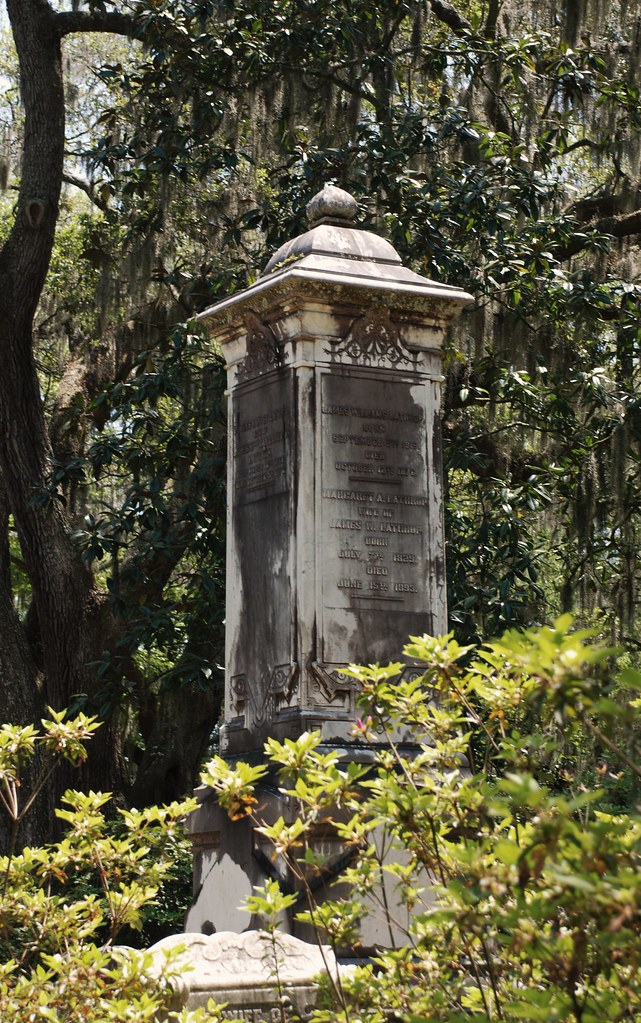
Bonaventure Cemetery (Image by reynolds.james.e)

Should I have the opportunity to travel to Savannah, Georgia, I want to visit the Bonaventure Cemetery. It is known for its beautiful live oaks (Quercus virginiana) and for being the burial place of Johnny Mercer and Conrad Aiken. I've been curious about it ever since reading Midnight in the Garden of Good and Evil.

Bonaventure Cemetery overlooks the Wilmington River. The site was once part of a 600 acre farm named Bonaventure, established in 1762 by Colonel John Mullryne and his wife Claudia. Colonel Mullryne laid out an internal road system for the property and planted live oaks at close intervals along the roadsides. Some of these roadways today are the famous "oak alleys" of Bonaventure Cemetery.
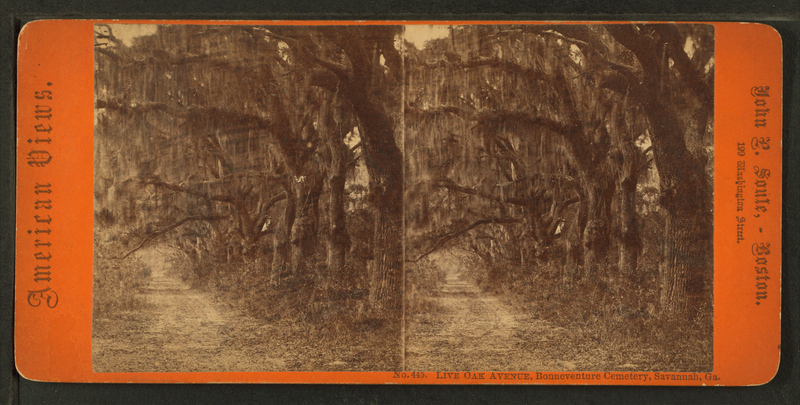
An antique stereoscopic view of
an oak alley at Bonaventure Cemetery.
Image from Wikimedia Commons

A family cemetery was established in the 1790s by a later owner of the plantation, Josiah Tattnall. The Tattnall family sold the plantation in 1846 to Peter Wiltberger. The Wiltbergers opened a 70-acre public cemetery (Evergreen Cemetery) on the property and assumed care of the original Tattnall burying ground (Old Bonaventure Cemetery). Evergreen Cemetery was taken over by the city of Savannah in 1907. The entire site, now 160 acres, is known as Bonaventure Cemetery today.

Donald Grant Mitchell wrote about Bonaventure Cemetery in Rural Studies: With Hints for Country Places. This book was published in 1867, so the live oaks were probably about 100 years old at the time of his visit.

Near to Savannah, in Georgia, and upon one of the creeks making into the irregular shores thereabout, is a cemetery called, if I remember rightly, Buena Ventura. In old times, any visitor at the Pulaski used to find his way there, and was richly repaid for the visit.

There was no proper "keeping" to the grounds. You passed in under a lumbering old gateway of unhewn timber; the paths were not carefully tended; there was much of rampant and almost indecorous undergrowth; the tombs were mossy, and the graves, many of them, sunken; but great liveoaks over-reached your path, and from their gnarled limbs hung swaying pennants of that weird gray moss of the Southern swamp lands—festooned, tangled, streaming down—now fluttering in a light breeze, and again drooping, as if with the weight of woe, to the very earth.

There was something mysteriously solemn and grave-like in it. The gnarled oaks and the slowly swaying plumes of gray told the completest possible story of the place. Had there been no tombs there, you would have said that it was the place of places where tombs should lie and the dead sleep. I have alluded to the scene only to show what and how much may be done by foliage and tree limbs, with their investing mosses, to give character to such a spot. (Source)

In A Thousand Mile Walk to the Gulf, John Muir recalled the days he spent camping in the Bonaventure Cemetery in 1867 while he was waiting in Savannah for money to arrive. Of the live oaks, he wrote:

The most conspicuous glory of Bonaventure is its noble avenue of live-oaks. They are the most magnificent planted trees I have ever seen, about fifty feet high and perhaps three or four feet in diameter, with broad spreading leafy heads. The main branches reach out horizontally until they come together over the driveway, embowering it throughout its entire length, while each branch is adorned like a garden with ferns, flowers, grasses, and dwarf palmettos.

But of all the plants of these curious tree-gardens the most striking and characteristic is the so-called Long Moss (Tillandsia usneoides). It drapes all the branches from top to bottom, hanging in long silvery-gray skeins, reaching a length of not less than eight or ten feet, and when slowly waving in the wind they produce a solemn funereal effect singularly impressive. (Source)

Live oaks at Bonaventure Cemetery, early 1900s.
Library of Congress, Prints and Photographs
Division, Detroit Publishing Company Collection.

Bonaventure Cemetery
Image by bp6316 is BACK
I doubt if the cemetery is as overgrown and natural a place today as it once was, but its live oaks are still there. In 2004, they were placed on the Georgia Landmark and Historic Tree Register.

The Savannah Department of Cemeteries reports that the live oaks have been in "slow decline" for the last century, after surviving a number of major hurricanes during the 1800s. I hope that some younger live oaks are growing so the unique atmosphere and beauty of Bonaventure Cemetery is preserved for future generations.

Further reading
Quercus virginiana
Live Oak, USDA Forest Service Sylvics Manual
Floridata: Quercus virginiana
Discover the Bonaventure Cemetery
Bonaventure Cemetery, Savannah

Monday, April 12, 2010

A fine log house in Todd County, KY

Walnut shingles and tongue-in-groove floors


Many early log houses in Kentucky were built quickly and roughly. They were small structures with dirt floors and leaky roofs. They sheltered a pioneer family from wild animals, hostile Indians, and the worst of the weather. Perhaps when the fields were cleared, the barns and the fences were built, and a few harvests had been made, a larger, better house might be built.

This log house, built in Todd County sometime before 1809, was exceptionally well-made:
There were a few cabins which were quite pretentious and one of these had the first shingle roof in the county. It belonged to Adams, who sold out to Kennedy in 1809, and is thus described by the latter: "Adams was a thrifty, industrious man, and said to my father, 'I gad, I thought I would build the best and finest house in all the country.' It was constructed of large, hewed white oak logs, twenty-four feet long by eighteen feet wide, covered with black walnut shingles rounded at the butt end, and every one put on with walnut pegs, bored through shingles and lath with a brace and bit. It was a good roof, and lasted about thirty years.

"Then the lower and upper floors were laid with poplar plank, sawed by hand with a whip-saw, nicely dressed, tongued and grooved, and put down with pegs. Three windows two feet square, with nice shutters, but not a pane of glass, nor a nail in all the house, save in the three doors. For these a few nails were made by a blacksmith, his brother, Andy Adams. The chimneys were of stone, the first in the country, and contained at least 150 loads of rock. The fire-places were six feet wide, with wooden mantel-pieces."  -- History of Todd County, Ky., published by F. A. Battey Publishing Co. Chicago, 1884.

Source: Kentucky: A History of the State by William Henry Perrin, J. H. Battle, and G. C. Kniffin (p. 209). Published in 1888 by F. A. Battey and Company, Louisville and Chicago.

Todd County, KY,  is just east of Christian County where I live. The Todd/Christian county line is only a few miles from my home. I am familiar with the terrain of Todd County, and I suspect that this house may have been built in "North Todd", as we say here. White oak, black walnut, and tulip poplar were chosen because they were some of the most decay-resistant woods available.

A log house built in 1793, near Harrodsburg, Kentucky. Kitchen (at rear) with dogtrot added later. Photographed in 1940.  Library of Congress, Prints and Photographs Division, Historic American Buildings Survey, HABS KY,84-HARBU.V,2-

Sunday, February 14, 2010

Big white oak trees of the past

Giant oaks of the primeval forest


I came across an item in an old newspaper about a very large white oak that was harvested in Breckenridge County, Kentucky. It piqued my curiosity, so I located the stories of a few more big oaks that were cut from the virgin forests of the greater Ohio River valley. I've quoted four of the news items below.

As large as these white oaks were, they did not rival the size of a white oak that was cut in Holden, West Virginia, in 1938. That giant was reported to be the largest white oak in the world. It was 9 feet in diameter and nearly 100 feet tall, and it was estimated to contain 15,000 board feet of lumber.

Big Oak Log

It required ten horses to haul a big white oak log which was brought to town last week, by T. W. Sanders, to be shipped to Evansville[, Indiana, down the Ohio River]. The log measured out 1,519 feet, was 49 inches in diameter at the small end and 54 inches at the large end. It belonged to the timber firm of Cooper & Williams and was cut on a tract of land near Tar Springs. One of the finest lot of oak timber ever cut in the county was hauled to town this year from this tract of land, many logs out of several hundred averaging a thousand feet by measure.

Source: The Breckenridge news. (Cloverport, Ky.) November 02, 1904

Paris, [Kentucky,] May 17 [1900].--A big oak that has for many years been an object of Riley Howse in Nicholas county has been sold to Ossian Edwards, of Paris, for $110. It measured forty-five feet in circumference and seven feet five inches in diameter. Large crowds witnessed the fall of the monster tree.

Source: Crittenden press. (Marion, Ky.) May 24, 1900

A Big White Oak
From the Chicago Tribune

A short time ago a New-York firm sent an agent to Scottsburg, Ind., to purchase a large white oak tree, which measured 27 feet in circumference. They bought the tree for $75, and set to work to get out as large a board as possible. The tree was felled and ripped up by means of a crosscut saw. They got out one board that was 10 inches thick, 5 feet 2-1/2 inches wide at the butt and 4 feet 8-1/2 inches wide at the top and 32 feet long. This board was loaded upon a broad-tread wagon to which two yoke of oxen and eight horses were hitched, and it took one whole day to remove it one and a half miles. This was probably the largest white oak tree in the United States.

Source: The New York Times, April 7, 1889

The largest white oak tree ever cut in the United States came out of Trumbull county, Ohio, a few years ago. It was delivered to a timber mill, and measured 62 feet in length and seven feet through, and contained 7,365 feet of lumber, board measure. It was located by Mr. Helman's buyers on C. K. Shipman's farm in Gustavus, Ohio, and $100 bought it. The Helman Company dressed the stick down to 30 x 30 inches, 62 feet long and shipped it to New York, where it is now used as a dredge anchor.

Source: Reading Eagle, Feb. 2, 1908

Thursday, November 12, 2009

Ten Native Trees with Leathery Leaves

Trees with tough, durable foliage


Leathery leaves of Quercus stellata (post oak)
Image courtesy of Iowa State Extension Service

In tree books and nursery catalogs, the term "leathery leaves" is sometimes used. What does "leathery" mean?

Leathery is an adjective that is used to describe a leaf's texture -- that is, how it feels when you hold the leaf between your fingers. A leaf's texture is a entirely separate characteristic from its size, shape, or color.

"Leathery" is the opposite of delicate. Leathery leaves are tough and durable. They are a bit thicker than most leaves, and they're somewhat pliable. They have a texture that's similar to thin leather. They are not easily torn by accident. A leathery leaf would never be called "limp" -- rather, they are substantial leaves.

When you're wondering if a tree's foliage would be described as leathery, examine a mature leaf. The leaves of a few tree species are leathery as soon as they pop out of the bud, but the leaves of various others are delicate at first but become leathery as they mature.

Homeowners should be aware that leathery leaves are slow to deteriorate. Raking will be needed to remove fallen leaves from the lawn.

Here are some examples of deciduous native trees of North America that have leathery leaves. The Latin names are linked to the trees' respective pages in the USDA Plants database.

Alnus serrulata -- Hazel alder (leaf image)
Fagus grandifolia -- American beech (leaf image)
Liquidambar styraciflua -- American sweetgum (leaf image)
Magnolia acuminata -- Cucumbertree magnolia (leaf inage)
Prunus serotina -- Black cherry (leaf image)
Quercus alba -- White oak (leaf image)
Quercus bicolor -- Swamp white oak (leaf image)
Quercus prinus -- Chestnut oak (leaf image)
Quercus stellata -- Post oak (leaf image)
Rhododendron maximum -- Rosebay rhododendron (leaf image)

Sunday, October 25, 2009

Famous live oaks of Oak Alley Plantation

Quercus virginiana in splendid maturity


Oak Alley Plantation is famous for a long lane, lined with live oaks, which leads to a large mansion. The plantation is located near the Mississippi River, about three miles from Vacherie, Lousiana, between Baton Rouge and New Orleans.

The live oaks were planted early in the 1700s by an unknown French settler. In 1722, monks traveling through the area made note of the double row of vigorously-growing young oaks in their journals. The trees were 120 years old (or more) when the current plantation home was built in the late 1830s. The 28 trees of the alley were the architect's inspiration for the 28 columns of the house.

The alley is 80 feet wide and about 800 feet long. Each side has 14 trees. The planter of the oaks planned well for their ultimate size. He knew that he would never see them in their maturity; yet, he thought about what they could become and what their space requirements would be. The magnificence of his vision is fulfilled, three centuries later.

Live oak facts


Southern live oak (Quercus virginiana) is nearly always wider than it is tall. Live oaks commonly reach a height of 40-60 feet with a spread of 1-1/2 times the height or more. Individual specimens may be 80 feet in height and 120 feet or more in spread. Live oaks often live 400 years, and individuals may live longer.

The tree is renown for its extremely dense, heavy wood. The acorns are relished by a wide range of wildlife; they are said to be the sweetest of all oak acorns. Native Americans gathered and stored live oak acorns to thicken their stew. They also pressed them and extracted an oil.

Like all live oaks, Quercus virginiana is an evergreen tree, holding its leaves throughout the winter months. In spring, old leaves drop off and new leaves are formed.

More tree history at Oak Alley Plantation


Another interesting bit of tree history took place at Oak Alley Plantation,  In the 1840s, Antoine, a talented gardener who was a slave of the plantation, grafted the first paper-shell pecan trees. By 1865, 126 grafted papershell pecan trees were growing on Oak Alley Plantation. The variety of pecans which Antoine created became known as "Centennial".

Related websites:
Images of Oak Alley from Life magazine, 1952
Photographs of Oak Alley's trees and the mansion
Amazing images of big live oaks
Official site: Oak Alley Plantation

Photo credit: Wikimedia image by Rolf Müller, 2003.

Thursday, October 8, 2009

Bur oak: America's largest acorn

Mossy cup oak acorns


It's tree trivia time! Did you know that the acorn of the bur oak (Quercus macrocarpa) is North America's largest native oak acorn? A very large bur oak acorn might measure up to 2 inches in length.  Most bur oak acorns are in the range of 1 inch to 1-1/2 inches in length.

The bur oak is sometimes called  mossy cup oak, a name that refers to the fringe around the edge of the acorn cup. Usually, the cup covers about half of the nut, but occasionally, the cup will be so large that only the tip of the nut sticks out of the fringe. Another common name for the bur oak is overcup oak.

The twigs of bur oaks have corky ridges. If you click the photo above and enlarge it, you can see ridges on both sides of the twig, giving it an irregular, thickened outline.

The acorn in the photo is growing on a bur oak that my husband planted. In the fall, he gathered fallen acorns from the big bur oaks at his childhood home in Independence, Missouri. When he got back to Kentucky, he planted the acorns in clumps of half a dozen, a few inches deep. He wasn't particularly fussy or scientific about it. A number of little oak trees came up the next spring, and he thinned them down to this one.

This tree, and several other bur oaks he planted at the same time are now about 15 years old. At 25-30 feet, they are big enough that they are becoming significant trees in our landscape. They grew slowly at first because they were establishing their roots, but now they seem to be growing two  feet or more annually. They have been bearing acorns for several years.

The bur oak, a member of the white oak family, is native to much of the eastern United States and part of eastern Canada.  It commonly lives for several centuries and individuals trees in favorable conditions may live much longer. In maturity, it may reach 100 feet in height and in spread. Many creatures of the wild enjoy its acorns and some nibble the twigs as well.

Thursday, September 10, 2009

Bur Oak Canyon of Hitchcock County, Nebraska

Remnant population of bur oaks in southwestern Nebraska


A deep, rugged canyon just 2 miles long, surrounded by vast expanses of prairie, is an unlikely outpost for the bur oak (Quercus macrocarpa). Nevertheless, the Bur Oak Canyon in southern Hitchcock County, Nebraska, has sheltered a remnant bur oak population for thousands of years.

The stand of oaks in Bur Oak Canyon is believed to date back 5,000 to 10,000 years. Of the 300 to 400 bur oaks in the canyon today, some individuals may be 200 years old. They are the only known native bur oaks within 200 miles.

Forester Tim Buchanan of Fort Collins, Colorado, explains that after the last ice age ended about10,000 years ago, the climate became favorable for oaks to spread across the prairies. Oaks advanced even into some parts of Canada. Then about 5000 years ago, the climate became hot and dry on the Great Plains -- and in the area of the Bur Oak Canyon. Oak trees on the surrounding prairies died from the stress of prolonged drought.

The microclimate and geology of the deep canyon helped the bur oaks survive. The bur oak's long taproot also gave the tree a survival advantage. A bur oak seedling sends its taproot deep into the ground before it begins to add height above ground. In the first growing season, it may develop a taproot over a yard in length. It also develops an extensive system of lateral and feeder roots. 

It is suspected that the bur oaks in the canyon carry some genes from hybridizing long ago with other oaks, probably with gambel oaks (Quercus gambelii) and post oaks (Quercus stellata). Gambel oaks are native to South Dakota, Colorado, and the American Southwest. Post oaks are native to most of the Eastern United States. Neither post oaks nor gambel oaks are native to Nebraska today -- presumably they died out in the great drought 5000 years ago, if they ever grew in the area.

Due to cattle grazing in the canyon (which is privately owned and part of a ranch) and a lack of squirrels to disperse the seed, seedlings have a hard time getting started.

The activities of the 2009 Bur Oak Symposium include planting seedlings and acorns, and protecting new and established seedlings. The goal is to reestablish and preserve the stand of oaks in Bur Oak Canyon for the future.

More about Bur Oak Canyon:
Bur Oak Symposium 2008
Bur Oak Symposium 2009
Bur Oak Canyon -- Flickr photoset
Bur Oak Canyon -- Flickriver photoset

Related
Bur Oaks Grown from Seed -- Flickriver photoset

Images in this post are from Wikipedia.

Sunday, August 16, 2009

Big Oak Tree State Park

An important place for me to visit


I'll be 58 next month, and I've been thinking about some things I'd like to see and do during my 58th year. I must admit that some of these things could/should have been done long ago -- but better late than never, no?

One of my goals is to visit Big Oak Tree State Park, in extreme southeastern Missouri. I've crossed the Mississippi and Ohio Rivers at Cairo, Illinois, dozens of times. However, I've never taken the time to turn off the main road and drive 25 miles south to the park. I'm always in a hurry, on a trip to visit my family.

The park has a very interesting history. This area, already a flood-plains forest, sank up to 50 feet in some places during the great New Madrid Earthquake of 1811. Swamps became swampier. As settlers populated the area, they recognized the agricultural potential of the rich, alleuvial soil, and a century of reclamation began, with the goal of creating as much farmland as possible.

By the 1930s, nearly all of the swamps had been drained and nearly all of the forest had been cleared. One tract in Mississippi County, soon to be logged, contained the largest bur oak tree that has ever been known. Public sentiment was aroused, and a statewide effort began to save the big bur oak and to preserve a remnant of Missouri's great forest of the Mississippi floodplain.

Because of the Great Depression, the state of Missouri did not have enough funds to purchase the acreage where the tree grew. With a combination of state funds, private donations, and the generosity of concerned citizens who gave what they could, enough money was raised to buy 1007 acres of virgin hardwood forest in Mississippi County. This purchase included the tract of land with the giant bur oak tree. In 1938, the Big Oak Tree Park was dedicated.

The bur oak fell in the 1950s. Its death at the advanced age of 396 was attributed to lightning strikes and rot. The tract of land where it grew is now a National Natural Landmark. The National Park Service describes the area as "the only sizable tract of essentially virgin wet-mesic bottomland habitat."

In addition to the champion bur oak, the park has been a home to other state and national champion trees as well.  Missouri State Parks information says that "...trees in the park are unsurpassed in the state for their size, with a canopy averaging 120 feet and with several trees more than 130 feet tall. Five trees qualify as state champions in their species; two others rank as national champions."

The park is attractive to bird-watchers as well as tree-lovers. Around 150 species of birds have been observed there, including some very rare species that have not recently been seen -- and that brings me to a sad ending for this story.

It seems that the park's forest is not in good health. According to an article in American Forests, the old trees are dying and seedlings are not growing. The cane brake is also dying.

Part of the problem is a lake that was built in the park in 1959, destroying the natural swamp that had been there. Drainage systems within the park, designed to prevent flooding of nearby farmland in wet weather, have deprived the ecosystem of the water it needs to sustain itself. Beaver dams were dynamited, also increasing the drainage. Foresters are trying to correct these mistakes now, but it may be too late for the forest to recover.

So I must visit Big Oak Tree State Park sometime soon -- as soon as possible. 

Images in this post are from Wikipedia. The map is from the article "Big Oak Tree State Park" and the photo is from an upload page titled "Big Oak Tree State Park Boardwalk". I highly recommend viewing the full-resolution version (3.96 MB ) of the photo above. Thank you to Knowledgeum, the photographer.

Saturday, June 6, 2009

Oak galls: Old-time source of ink

Gall-iron ink once used widely


Today, I waited in a parking lot for my daughter to come out from her workplace. I noticed that every pin oak around the building was afflicted with galls. Galls are lumps that form on tree branches when the larvae of insects invade. It is thought that the insects emit a chemical that reacts with the tree's natural growth hormones and growth is grossly overstimulated in the area.

If I had cut a gall open, I probably would have found some of the larvae of the invading insect. If it is the horned oak gall wasp, the number of larvae inside the gall might have ranged from 1 to 160, depending on the size of the gall (Source: Biology and management of the horned oak gall wasp on pin oak.)

The galls usually don't kill pin oaks, but they can cause the branches to die back. I observed this condition on several of the pin oaks around the parking lot. And even if the tree doesn't die, it's greatly disfigured. See the image of a gall-laden tree at this post: Galls on a young pin oak tree.

In the book American Forest Trees (published by Hardwood Record, Chicago, 1913, pp.303-304),  Henry H. Gibson records an interesting historic fact about galls in a chapter about pin oaks:

Oak apples or galls are the round excrescences formed on the limbs by gallflies and their eggs. They seem particularly fond of this species and specimens are often seen which are literally covered with them. The worms which live inside seem to flourish particularly well on the food they imbibe from pin oak.

The primitive school teachers three or four generations ago turned these oak galls to account. They are rich in tannin and were employed in manufacturing the local ink supply. The teachers were the ink makers as well as the pen cutters when the pens were whittled from quills

The process of making the ink was simple. The galls were soaked in a kettle of water and nails. The iron acted on the tannin and produced the desired blackness, but if special luster was desired, it was furnished by adding the fruit of the wild green brier Smilax rotundifolia which grew abundantly in the woods. It was well that steel pens were not then in use for the schoolmaster's oak ink would have eaten up such a pen in a single day.
(Source)

Galls on a young pin oak
(Seen in March)

I was quite fascinated to learn that the U.S. Constitution is written with iron gall ink as well as many other documents written by the founding fathers. In fact, iron-gall ink was widely used for centuries.

Iron-gall ink was the primary writing ink used from 12th through the 19th centuries in the Western world. Popular with artists, architects and mapmakers, iron-gall ink is found in abundance in paper-based collections at the Library of Congress.
Source

The tannin in these inks seems to hold up well, but the iron is a problem for conservationists because it wants to corrode.

I doubt that oak galls have been put to a useful purpose since the days they were used for ink-making!

Friday, May 22, 2009

Natural shape of the pin oak

Don't try to change the pin oak's shape by pruning.


The pin oak (Quercus palustris) has a characteristic shape. It has a long central trunk. Its upper branches always lift to the sky. Its middle branches extend more or less horizontally from the trunk. Its lowest branches always droop toward the ground.

The pin oak's shape is usually described as pyramidal or sometimes as conical. The unique angles of its branching and the presence of many pins --short stubs on the trunk -- are reliable clues to its identification.

A pin oak tree will do its best to maintain the characteristic shape of its species. If its lower branches are removed, the next branches that are lowest on the trunk will gradually begin drooping toward the ground.  For this reason, pin oaks are not very good for planting along narrow streets or in parking lots.

I hate to see a pin oak that's been deformed by excessive pruning in an effort to keep its lower branches from drooping into human zones. Here's an example of what I'm talking about -- a much abused pin oak that grows in a field of asphalt near the Bradford Square Mall in Hopkinsville, KY.

Why don't landscapers think about the size and shape and spread a tree will have in maturity when they plant it? Thinking ahead would be so much better than spending years fighting the natural tendencies of a tree. Just my opinion.

Photo of pin oak in winter provided by Robert Underwood.

Tuesday, April 14, 2009

The very best firewoods

Six excellent woods for heat


Here's a list of six of the best firewoods. (The number in parenthesis is millions of BTUs produced by a cord of this wood under optimal conditions.)

  • Sugar maple (25.0)
  • Red oak (25.3)
  • White oak (27.0)
  • Black locust (28.1)
  • Shagbark hickory (29.1)
  • Osage orange (30.7)
(Source: Wood Fuel for Heating, a University of Missouri extension service publication)

A few years ago, I did a lot of research on wood stoves as we prepared to buy a new one. In one online forum, I read an interchange between a New Englander and a Midwesterner. The Midwesterner wondered whether a certain brand of wood stove would withstand the hot fires he liked to made with hedge (Osage orange) firewood.

The New Englander replied that he made hot white oak fires all the time in his wood stove of that brand. He said with considerable scorn that he doubted if hedge could burn as hot as the fine white oak of the East Coast. He should have done a little research because, according to the University of Missouri publication linked above, he was mistaken.

Monday, March 23, 2009

Post oak flower

Blossom of Quercus stellata


If you live in western Kentucky, you can probably find a post oak (Quercus stellata) in bloom right now. I photographed this one yesterday in Christian County. The blossoms are inconspicuous -- small without much color.

Related post with an image from the same post oak tree:

Saturday, February 21, 2009

Nine native trees that hold leaves in winter

Native broadleaf trees with persistent foliage


Have you noticed that a few broadleaf trees change color in fall, but don't drop their leaves? Many of their brown leaves cling to the tree throughout winter and early spring until new leaf growth begins. This characteristic is called marescence.

Here are nine native trees that behave in this fashion.


Perhaps it's no surprise to you that the majority are oaks. Owners of these oak trees often complain that they shed leaves all winter long. I know an elderly lady who is very opposed to oaks as the national tree. She has lived her entire adult life under big white oaks, and she hates the way they drop their leaves a little at a time, all winter. "Just not tidy trees," she told me.

Trees with some winter foliage will perform better as a windbreak, screen, or sound barrier than trees that have dropped all their leaves.

They will also cast more shade in the winter than trees that have dropped their leaves. Sunshine on the house in winter is generally a good thing, so consider that when choosing a planting site for a tree that keeps winter leaves.


Our pin oak on the evening of February 21.
Look at all those leaves!


Image credit: Pin oak leaf drawing by J. R. Stacy of the U.S. Geological Survey.

Thursday, February 21, 2008

Trees with fine foliage

Trees with small leaves or leaflets


Hawthorn leaves and berriesWhy choose a tree with fine foliage rather than coarse foliage? One reason is to create an optical illusion. You can make a small yard appear longer by using plants and shrubs with large leaves in the foreground and trees with small leaves in the background.

Trees with fine foliage don't make as much of a mess when the leaves drop in autumn. The leaves break down faster and blow away easier. Thus, less raking is required. A few passes with the lawn mower may eliminate the need to rake at all.

Most trees with finer foliage don't create dense shade. Grass and many plants, flowers, and shrubs do better in dappled shade than in dense shade.

I've listed a few native trees below that have small or fine foliage. There are others, but I've limited the list to some that come through most ice/wind events without severe damage.

Of course, there are other factors to consider as well, such as the type of soil and the amount of moisture that will be available to the tree. Links will open an information page about the species at the USDA Plants database.

Amelanchier canadensis -- Canadian serviceberry
Carpinus caroliniana -- American hornbeam
Crataegus -- Hawthorn species
Gymnocladus dioicus -- Kentucky coffeetree
Malus ioensis -- Prairie crabapple
Ptelea trifoliata -- Common hoptree
Quercus palustris -- Pin oak
Viburnum prunifolium -- Blackhaw viburnum
Viburnum rufidulum -- Rusty blackhaw viburnum

Technorati tags: ,

Thursday, January 31, 2008

Tall trees that resist wind and ice damage

23 tall-growing native trees that resist wind and ice damage


Updated, 3/6/10.

All of these trees can reach 75-100 feet in height or more when mature. All are native trees of North America with moderate to good resistance to damage by wind and ice.

Trees marked with an asterisk below should be considered moderately resistant. A general rule to remember is that strong evergreens are not as resistant to wind and ice damage as strong deciduous trees. Because of their foliage, they tend to catch more winter wind, snow, and ice. (That's why evergreen trees are often planted in windbreaks.)

1. Acer nigrum -- Black maple
2. Acer saccharum -- Sugar maple*
3. Carya cordiformis -- Bitternut hickory
4. Carya glabra -- Pignut hickory
5. Carya illinoensis -- Pecan
6. Carya ovata -- Shagbark hickory
7. Carya tomentosa -- Mockernut hickory
8. Fagus grandifolia -- American beech
9. Gymnocladus dioicus -- Kentucky coffeetree
10. Juglans nigra -- Eastern black walnut
11. Liquidambar styraciflua -- American Sweetgum
12. Magnolia acuminata -- Cucumbertree magnolia
13. Picea pungens -- Colorado spruce
14. Pinus ponderosa -- Ponderosa pine*
15. Pinus resinosa -- Red pine*
16. Platanus occidentalis -- Sycamore, American planetree*
17. Quercus alba -- White oak
18. Quercus bicolor -- Swamp white oak
19. Quercus borealis -- Northern red oak
20. Quercus macrocarpa -- Bur oak*
21. Quercus velutina -- Black oak
22. Taxodium distichum -- Common baldcypress
23. Tsuga canadensis -- Canada hemlock*

Remember -- if the weather is bad enough, any tree can lose branches, snap its trunk, or even lose its grip and fall over. You should use good judgment about keeping your home safe. It's not wise to have big trees next to your house, no matter what kind of trees they are. 

For a (usually) safe distance between house and tree, allow half of the mature tree's spread (half of the diameter of its crown). If the mature tree will have a spread of 70 feet, it should be planted at least 35 feet from any buildings. This does mean that many suburban properties are too small for large trees.

If you want a guarantee that you will never have to cope with fallen branches or storm-damaged trees, simply remove all trees from your property. That should eliminate the problem.

Sources for the above list include:

Native Trees, Shrubs, and Vines for Urban and Rural America: A Planting Design Manual for Environmental Designers by Gary L. Hightshoe, published in 1988 by Van Nostrand Reinhold, New York.

Ice Storm Damage to Urban Trees, an article in the appendix of Storms Over the Urban Forest, a publication of the USDA Forest Service. (This article's table, "Ice storm susceptibility of tree species commonly planted in urban areas" is reprinted in many reputable articles about ice damage susceptibility on the internet.)

Trees For Nebraska Ice Storm Recovery and Susceptibility of Trees to Ice Storm Damage in the Great Plains, published by the Nebraska Statewide Arboreum

Tuesday, January 22, 2008

A Reader Asks for Tree Identification

Mysterious trees on Oak Island


I've always said that one of the most interesting things about blogging is the comments, both on the blog and via e-mail. Here's one I received a few days ago.

Dear Genevieve,

I am studying a species of Oak which is non-native to Eastern Canada. To date, my colleagues and I have been unable to identify which species of Quercus it is. The last tree disappeared sometime in the late 1960's, so all that we have to work with is the pictures of these trees. Do you think that you could take a look and render an opinion for us?

Robert


I wrote back:

I will be glad to look, but please keep in mind that I am just an interested amateur, not a trained professional!


Robert sent the following image and a little more information about it:

Many thanks, Genevieve. These Oak trees were found on Oak Island, off of the coast of Nova Scotia, Canada. They are not native to the region and are not found anywhere else, but on this island up to about 1969 or so, when the last ones disappeared. I suspect that they were planted there specifically by early visitors, perhaps between 1560 and 1670. They are unusual because of their broad canopies. Image attached. Thanks again and I surely hope that you recognize them!


I didn't recognize the trees, and I wrote back:

I am not able to identify them, I regret to say. Their shape is curious, not so much because of the broad canopy, but because of the apparent lack of foliage below the canopy. I wonder if that might have been a phenomenon caused by the stress of growing in an environment that wasn't its natural home?

If you'd like, I can post the image on the blog and see if anyone else has any comments.


Robert replied:

Many thanks for taking a look, Genevieve. I would be grateful to learn anything else about them, so a post on your blog would be great. We thought that we had a sample of the trees from a log found on the island. I sent a sample for analysis to the Center for Wood Analysis Research and it came back as a species of Maple. I suspect that we had the wrong stump, as the common belief was and is that they are a species of Oak...

Your insight regarding the environment is probably correct. The unusual shape of the canopy, etc. is likely the result of the North Atlantic seaboard environment, which is known to be harsh as a result of the Nor'easters, as well as perhaps the soil and other conditions. In any event, they apparently thrived there for a number of centuries and of course, is why Oak Island is so named. We believe that they were planted there specifically for timber used in the repair (careening) of ships, but this is just a theory. Hopefully, someone will recognize them from the image, so I will keep my fingers crossed!


Robert is a member of an Oak Island research group. If you're not familiar with the story of Oak Island, it is fascinating. The story was new to me, but my son was well-informed about the mysterious treasure hole and the many attempts that have been made to explore it, having read about it in his some of his "mysteries of the unexplained" books.

Readers, do you recognize the tall trees in the image above, or do you have any comments about them? If so, please post them, or let me know by e-mail. Thanks.

Monday, January 7, 2008

Mighty Oaks in Hopkinsville, KY

Beautiful old trees, currently safe from development


Big oak trees in Hopkinsville, KY

These big, beautiful oaks grow at the edge of a small field within the city limits of Hopkinsville, KY. This photograph was taken from the Aldi's parking lot. The trees grow on a knoll, just above Little River.

I was worried about these trees six or eight years ago when someone bought the lot just to the north of them and constructed the building you can see at the left in the photo. Their roots were surely disrupted by the activity, but they have survived.

As it turns out, the gentleman who put up the building also bought the lot where the trees stand. He didn't want anyone else to buy it and cut the trees down. I'm glad that the oaks in the photo are protected for now by someone who appreciates them.

I have stopped and examined some of the other big oaks that grow in this field a little farther down the road, and I believe them to be Southern red oaks (Quercus falcata.) I've always thought that the oaks in the photo are probably Southern red oaks too, though I've never had a chance to look at them closely.

The field is for sale, so the future of the other big oaks that grow in it is uncertain. I don't think that Hopkinsville has a tree ordinance to protect trees like these. They are at the mercy of the landowner, though they enhance the quality of life of all who live in Hopkinsville.

Friday, January 4, 2008

Bur oak favored by Minnesota tree experts

Quercus macrocarpa, a favorite Minnesota tree


Cliff Johnson, a Master Gardener and writer from Minnesota, took an informal survey of some Minnesota horticulturists, nursery owners, arborists, etc., asking this question:
“Assume you have moved into a new home and yard with adequate space and sunlight, good drainage and okay soil. What one large tree and one small tree would you plant in your new yard, and why?" (Source)

I'm pleased that Johnson reports a unanimous vote for bur oak (Quercus macrocarpa) as the favorite large tree. It's one of my favorite trees as well. We have about half a dozen bur oaks planted in our yard, that we grew from acorns gathered from my husband's childhood home. ("Sentimental" only begins to describe my husband's attachment to these trees.)

Johnson's panel of experts mentioned several other trees that are North American natives or cultivars thereof:

  • Swamp white oak (Quercus bicolor)
  • 'Shademaster' honeylocust (Gleditsia triacanthos var. inermis)
  • 'Autumn Purple' white ash (Fraxinus americana)
  • Kentucky coffeetree (Gymnocladus dioicus)

One quality that the experts liked about several of these trees was their appearance in winter. Truly, that's important to consider if you live in an area where the trees are leafless for several months in cold weather. A tree with a rugged, interesting form is a joy to behold during the bleak months of winter -- especially when the tree's structure is highlighted by snow on its branches.

Quercus macrocarpa at the
Heard Natural Science Museum,
McKinney, TX. Photo by Flickr
user Bonita La Banane
Image: A handsome, mature bur oak on Holly Avenue in St. Paul, Minnesota.

Resource: Cliff Johnson, the Minnesota Master Gardener who wrote the article I've been discussing, has a great website, "Putting Down Roots" where you can read dozens of his gardening columns.

I came across this Johnson article at the Shakopee (MN) Valley News. I went to Johnson's website to try to locate the true source of the article. Half an hour later, I still can't say if the article came from there. I got caught up in reading other interesting things!

Related: Article about a bur oak in Plano, Texas. Bur oaks are native to areas with an amazing variety of growing conditions, from north to south in the eastern and central U.S.!

Friday, December 28, 2007

A Champion White Oak in Maryland

Flora's Oak is recommended for honor.


The Wye Oak was Maryland's biggest white oak from 1925 to 2002 when a storm took it down. The apparent heir to its title is Flora's Oak, which grows on a farm near Barnesville in Montgomery County, Maryland (about 45 miles northwest of Washington D.C.).

The tree, named Flora's Oak in honor of a relative, is estimated to be 200 to 300 years old and stands 107 feet tall, with a trunk circumference of 22.3 feet and a crown spread of 115 feet. It doesn't have the girth of the Wye Oak, whose hollowed-out trunk was more than 31 feet around, and its crown is four feet narrower. But the Pepes' tree is 11 feet taller.

Source: "Mighty Oak Poised to Become MD State Tree") by Susan DeFord, Washington Post, December 28, 2007.


The Pepes family, owners of the farm where the big white oak grows, have been giving their tree some TLC since they became its owners. The steps they took will help most any tree achieve its maximum size and maintain its health:

-- Clearing away underbrush and competing trees
-- Allowing the branches to spread freely and achieve a natural balance
-- Installing grounding wires to protect it against lightning strikes
-- Having professional arborists check it for disease and insects
-- Avoiding herbicide use in the area
-- Applying fertilizer regularly

The article I read about Flora's Oak didn't say that the Pepes family had been watering the tree during dry spells, but surely they have been.

Maryland state quarterFlora's Oak has been growing since the Pepes family took over its care, 17 years ago. It's now 1.8 feet larger in trunk circumference, 17 feet taller, and 22 feet wider in the crown. Not bad for one of nature's slow-growers.

Officials of Montgomery County have recently written to the Maryland governor's office asking that Flora's Oak be declared the Maryland State Tree.

Maryland honors the white oak, its state tree, on its state quarter, and well it should because mighty white oaks do grow in Maryland.

Technorati tags: , , ,

Thursday, November 15, 2007

A Handsome White Oak

One of my favorite trees in our neighborhood


Large white oak growing in a front yard

One of our neighbors has a beautiful, big white oak in his front yard. He didn't plant it. It has been growing for many, many years.

I knew an old man who was born in this house. He has passed away now, but if he were living, he would be about 90. He told me that the tree was there when he was a child, and it was a big tree then (at least to his little eyes.)

I took this photograph about ten years ago. Since then, our neighbor has torn down the old house and built a new house.

I was a little worried that the tree might be hurt during the construction, but I think it's going to be all right. It probably didn't have many roots where the new house was built, directly behind the site of the old house.

This is one of my favorite trees. Even though I don't own it, I enjoy seeing it and I have an affectionate concern for it.

According to Gary Hightshoe's Native Trees, Shrubs, and Vines for Urban and Rural America (see book info at the bottom of this column), one of the sites that the white oak (Quercus alba) likes is "moist, warm, south, or west facing slopes."

The white oak in the photo grows on a gentle slope that faces south, just above a river. In fact, the river is about 100 yards from the sign in the foreground of the photo. White oaks can't tolerate flooding, but even on the rare occasion that the river is out of its banks, this tree is far enough up the slope that it won't stand in water.

It's hard to guess how old it might be. White oaks are very slow growing , but they are very long-lived. They usually live 350 to 400 years, and they often live 500 years or more. Truly, when you plant a white oak, you plant it for your grandchildren and their grandchildren.

You could also say that you plant it for the birds and animals. White oak acorns are the least bitter of all the oak mast. They are a valuable food for a wide range of birds and animals. Even bears will eat white oak acorns.

Related:
Quercus alba info in the USDA Plants database
White oak info at the Virginia Tech. Dept of Forestry website

Click any label...

advice (45) alder trees (1) Arbor Day (1) ash trees (11) Atlantic white cedar (1) atmosphere (2) autumn (1) bald cypress trees (8) bark (8) bayberry trees (1) beech trees (8) big trees (11) birch trees (2) black cherry trees (1) black locust trees (2) black walnut trees (7) Bradford pear trees (2) buckeye trees (2) butternut trees (1) catalpa trees (4) cherry trees (2) chestnut trees (1) Christmas trees (1) copyright (1) corkwood (1) crabapple trees (1) dogwood trees (6) drought (2) Eastern redbud trees (5) Eastern redcedar (5) ecosystem (6) education (5) elm trees (4) emerald ash borer (11) Empress tree (2) fast growing trees (7) festivals and carnivals (2) fir trees (1) firewood (6) foliage (11) forest (14) forest fires (1) forestry (7) freebies (2) ginkgo trees (1) hackberry trees (4) hawthorn trees (3) hemlock trees (1) hickory trees (11) historic trees (9) history (42) holly trees (1) honeylocust trees (2) hophornbean trees (1) hoptree (1) hornbeam trees (2) internet (3) invasive (13) juniper trees (5) Kentucky coffeetree (2) landscaping (3) larch trees (1) linden trees (1) logging (4) maple trees (10) mimosa trees (3) mistakes (14) narrow trees (1) native fruit (9) native trees (16) oak trees (38) old growth forests (5) ornamental trees (6) osage orange (5) pawpaw trees (1) pecan trees (1) persimmon tree (3) pine trees (9) poems (5) poison-sumac (1) poplar trees (10) prehistoric trees (3) quizzes etc. (1) rhododendron trees (1) sassafras trees (3) serviceberry trees (2) Silver maple trees (2) small trees (4) spring (7) spruce trees (4) statistics (2) sumac trees (4) sweetgum trees (4) sycamore trees (10) tall trees (5) tree cavities (1) tree identification (8) Tree of heaven (2) tree planting (11) tree problems (40) tree removal (2) tree roots (5) trees for problem spots (7) tuliptrees (tulip poplar) (2) urban forest (7) viburnum trees (1) wetlands (5) wild plum trees (4) wildlife trees (27) willow trees (6) witchhazel trees (1) woodworking (2) yellowwood trees (1) yew trees (1)

Enrich your life with the study of trees.

"The power to recognize trees at a glance without examining their leaves or flowers or fruit as they are seen, for example, from the car-window during a railroad journey, can only be acquired by studying them as they grow under all possible conditions over wide areas of territory. Such an attainment may not have much practical value, but once acquired it gives to the possessor a good deal of pleasure which is denied to less fortunate travelers."

Charles Sprague Sargent (1841-1927)

Print references I frequently consult

Benvie, Sam. Encyclopedia of North American Trees. Buffalo, NY: Firefly, 2000.

Brockman, C. Frank. Trees of North America: A Guide to Field Identification. Ed. Herbert S. Zim. New York: Golden, 1986.

Cliburn, Jerry, and Ginny Clomps. A Key to Missouri Trees in Winter: An Identification Guide. Conservation Commission of the State of Missouri, 1980.

Collingwood, G. H., Warren David Brush, and Devereux Butcher. Knowing Your Trees. Washington: American Forestry Association, 1978.

Dirr, Michael. Dirr's Hardy Trees and Shrubs: an Illustrated Encyclopedia. Portland, Or.: Timber, 1997.

Elias, Thomas S. The Complete Trees of North America; Field Guide and Natural History. New York: Book Division, Times Mirror Magazines, 1980.

Grimm, William Carey. The Book of Trees;. Harrisburg, PA: Stackpole, 1962.

Hightshoe, Gary L. Native Trees, Shrubs, and Vines for Urban and Rural America: a Planting Design Manual for Environmental Designers. New York: Van Nostrand Reinhold, 1988.

Little, Elbert L. National Audubon Society Field Guide to North American Trees. New York: Chanticleer, 1996.

Martin, Alexander C., Herbert S. Zim, and Arnold L. Nelson. American Wildlife and Plants. New York: McGraw Hill, 1951.

Mitchell, Alan F., and David More. The Trees of North America. New York, NY: Facts On File Publications, 1987.

Randall, Charles E. Enjoying Our Trees. Washington: American Forestry Association, 1969.

Settergren, Carl D., and R. E. McDermott. Trees of Missouri. Columbia: University Extension, 1995.

Sternberg, Guy, and James W. Wilson. Native Trees for North American Landscapes: from the Atlantic to the Rockies. Portland: Timber, 2004.

Wharton, Mary E., and Roger W. Barbour. Trees and Shrubs of Kentucky. Lexington: University of Kentucky, 1973.

Wyman, Donald. Trees for American Gardens. New York: Macmillan, 1965.

Photos and text copyright © 2006-2013 by Genevieve L. Netz. All rights reserved. Do not republish without written permission. My e-mail address is gnetz51@gmail.com