Tree Notes is about trees -- especially native trees, trees for wildlife, and trees in history.

Showing posts with label history. Show all posts

Wednesday, November 10, 2010

Live Oaks of Bonaventure Cemetery

Historic trees in Savannah GA


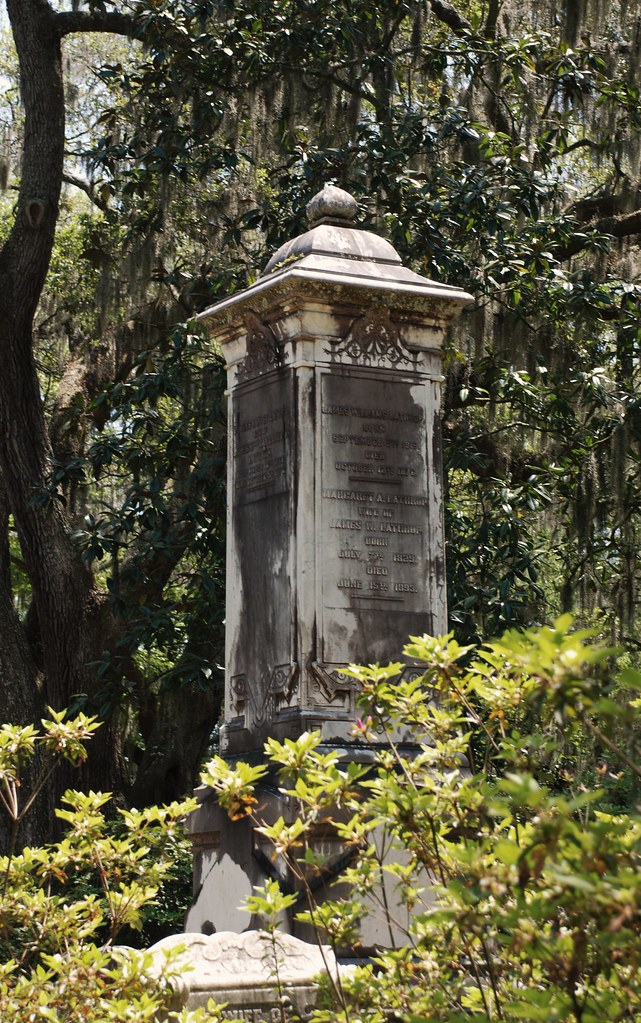
Bonaventure Cemetery (Image by reynolds.james.e)

Should I have the opportunity to travel to Savannah, Georgia, I want to visit the Bonaventure Cemetery. It is known for its beautiful live oaks (Quercus virginiana) and for being the burial place of Johnny Mercer and Conrad Aiken. I've been curious about it ever since reading Midnight in the Garden of Good and Evil.

Bonaventure Cemetery overlooks the Wilmington River. The site was once part of a 600 acre farm named Bonaventure, established in 1762 by Colonel John Mullryne and his wife Claudia. Colonel Mullryne laid out an internal road system for the property and planted live oaks at close intervals along the roadsides. Some of these roadways today are the famous "oak alleys" of Bonaventure Cemetery.
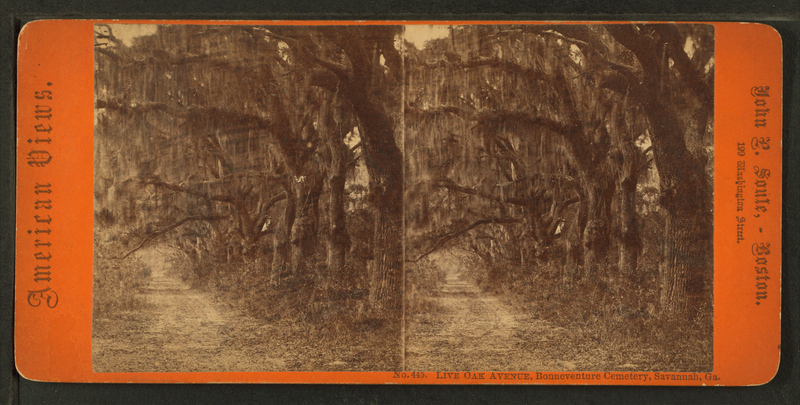
An antique stereoscopic view of
an oak alley at Bonaventure Cemetery.
Image from Wikimedia Commons

A family cemetery was established in the 1790s by a later owner of the plantation, Josiah Tattnall. The Tattnall family sold the plantation in 1846 to Peter Wiltberger. The Wiltbergers opened a 70-acre public cemetery (Evergreen Cemetery) on the property and assumed care of the original Tattnall burying ground (Old Bonaventure Cemetery). Evergreen Cemetery was taken over by the city of Savannah in 1907. The entire site, now 160 acres, is known as Bonaventure Cemetery today.

Donald Grant Mitchell wrote about Bonaventure Cemetery in Rural Studies: With Hints for Country Places. This book was published in 1867, so the live oaks were probably about 100 years old at the time of his visit.

Near to Savannah, in Georgia, and upon one of the creeks making into the irregular shores thereabout, is a cemetery called, if I remember rightly, Buena Ventura. In old times, any visitor at the Pulaski used to find his way there, and was richly repaid for the visit.

There was no proper "keeping" to the grounds. You passed in under a lumbering old gateway of unhewn timber; the paths were not carefully tended; there was much of rampant and almost indecorous undergrowth; the tombs were mossy, and the graves, many of them, sunken; but great liveoaks over-reached your path, and from their gnarled limbs hung swaying pennants of that weird gray moss of the Southern swamp lands—festooned, tangled, streaming down—now fluttering in a light breeze, and again drooping, as if with the weight of woe, to the very earth.

There was something mysteriously solemn and grave-like in it. The gnarled oaks and the slowly swaying plumes of gray told the completest possible story of the place. Had there been no tombs there, you would have said that it was the place of places where tombs should lie and the dead sleep. I have alluded to the scene only to show what and how much may be done by foliage and tree limbs, with their investing mosses, to give character to such a spot. (Source)

In A Thousand Mile Walk to the Gulf, John Muir recalled the days he spent camping in the Bonaventure Cemetery in 1867 while he was waiting in Savannah for money to arrive. Of the live oaks, he wrote:

The most conspicuous glory of Bonaventure is its noble avenue of live-oaks. They are the most magnificent planted trees I have ever seen, about fifty feet high and perhaps three or four feet in diameter, with broad spreading leafy heads. The main branches reach out horizontally until they come together over the driveway, embowering it throughout its entire length, while each branch is adorned like a garden with ferns, flowers, grasses, and dwarf palmettos.

But of all the plants of these curious tree-gardens the most striking and characteristic is the so-called Long Moss (Tillandsia usneoides). It drapes all the branches from top to bottom, hanging in long silvery-gray skeins, reaching a length of not less than eight or ten feet, and when slowly waving in the wind they produce a solemn funereal effect singularly impressive. (Source)

Live oaks at Bonaventure Cemetery, early 1900s.
Library of Congress, Prints and Photographs
Division, Detroit Publishing Company Collection.

Bonaventure Cemetery
Image by bp6316 is BACK
I doubt if the cemetery is as overgrown and natural a place today as it once was, but its live oaks are still there. In 2004, they were placed on the Georgia Landmark and Historic Tree Register.

The Savannah Department of Cemeteries reports that the live oaks have been in "slow decline" for the last century, after surviving a number of major hurricanes during the 1800s. I hope that some younger live oaks are growing so the unique atmosphere and beauty of Bonaventure Cemetery is preserved for future generations.

Further reading
Quercus virginiana
Live Oak, USDA Forest Service Sylvics Manual
Floridata: Quercus virginiana
Discover the Bonaventure Cemetery
Bonaventure Cemetery, Savannah

Friday, May 7, 2010

Trees mentioned in property surveys

Surveyors need to know their trees!


This oak tree in rural Christian County, KY,
probably marks the corner of a piece of property.

In 2010, it's still common to read in Christian County newspapers (and all across the Commonwealth) legal  descriptions of property that list natural features as corner markers. Quite often, the natural corner marker is a tree, and quite often, the tree is an oak.

The following paragraph, describing a Christian County property, is quoted from the June 20, 1988, Kentucky New Era.   This property description is noteworthy because it mentions seventeen trees -- and nine different species of trees.  (Emphasis added in the quote below.) 

TRACT VIII
BEGINNING at a red elm on the East bank of Pond River; thence North 67-1/2 East 86 poles to a planted stone; thence South 53 East 68 poles to a white oak and hickory; thence North 77 East 42 poles to a sugar tree; thence North 1-1/2 East 7 poles to a small crooked poplar in a drain, C. L. Pepper's corner; thence South 77 East 60 poles to a hickory and elm, Pepper's corner; thence North 33 East 65 poles to a white oak, Pepper's corner, thence South 27-1/2 East 34 poles to a black oak and sugar tree pointers; thence South 35 East 17 poles to a black oak; thence South 14 East 18 poles to a sugar tree; thence South 25, East 14 poles to a black oak; corner to Park Spring School House; thence South 20 East 34 poles to a white oak, A. Johnson's and Pepper's corner; thence South 41 West 76 poles to a stake and pointers in a line of a 100 acre survey; thence with it due West 16 poles to a stake in A. Johnson's line; thence North 55, West 92 poles to an elm; thence North 63-1/2 West 24 poles to a beech; thence South 49-1/2 West 5-1/2 poles to a box elder on the East side of Pond River; thence down said river with the meanders thereof to the BEGINNING, containing 100 acres, more or less. (Source)

The box elder tree, mentioned in the property description above, stood a good chance of dying before the next time the property was surveyed. If a box elder lives sixty years, it's an old tree. Presumably, it was already a tree of a few years and some size when the surveyor used it as a corner marker.

And what does a surveyor do when the trees in a property deed have died, been cut down, or cannot be found at all? Here are some examples of remedies:

"Beginning at a hickory and sycamore tree called for but now a stone planted..."

"...to a stake, formerly a black oak, standing on the East side of the road..."

"...thence with a cross fence north 6-1/2 west 59-1/2 poles to a dead white oak;"

"...identified by ancient description as beginning at the sugar tree on the bank of Coal Creek, near a spring; thence South 80 East 39 poles to a hickory called for but not found, a white oak marked as a corner..."

" Beginning at a fallen sycamore on the east bank of Coal Creek..."

"...thence south 75-1/2 W. 140 poles to a stone, a dogwood called for in old deed...thence N.E. 19 poles to a stone, a black oak called for..."

"...thence 87 E 84 poles to a stake in the edge of an old field (some black gum bushes and white oak called for, not found)..."

"Beginning at four (4) fallen pin oaks that grew in a two foot crevice between two large rocks (trees are lying there)..."

"...thence with his line South 50 degrees West 40-1/4 poles to a rotted stump, corner of the Jones tract..."

Monday, April 12, 2010

A fine log house in Todd County, KY

Walnut shingles and tongue-in-groove floors


Many early log houses in Kentucky were built quickly and roughly. They were small structures with dirt floors and leaky roofs. They sheltered a pioneer family from wild animals, hostile Indians, and the worst of the weather. Perhaps when the fields were cleared, the barns and the fences were built, and a few harvests had been made, a larger, better house might be built.

This log house, built in Todd County sometime before 1809, was exceptionally well-made:
There were a few cabins which were quite pretentious and one of these had the first shingle roof in the county. It belonged to Adams, who sold out to Kennedy in 1809, and is thus described by the latter: "Adams was a thrifty, industrious man, and said to my father, 'I gad, I thought I would build the best and finest house in all the country.' It was constructed of large, hewed white oak logs, twenty-four feet long by eighteen feet wide, covered with black walnut shingles rounded at the butt end, and every one put on with walnut pegs, bored through shingles and lath with a brace and bit. It was a good roof, and lasted about thirty years.

"Then the lower and upper floors were laid with poplar plank, sawed by hand with a whip-saw, nicely dressed, tongued and grooved, and put down with pegs. Three windows two feet square, with nice shutters, but not a pane of glass, nor a nail in all the house, save in the three doors. For these a few nails were made by a blacksmith, his brother, Andy Adams. The chimneys were of stone, the first in the country, and contained at least 150 loads of rock. The fire-places were six feet wide, with wooden mantel-pieces."  -- History of Todd County, Ky., published by F. A. Battey Publishing Co. Chicago, 1884.

Source: Kentucky: A History of the State by William Henry Perrin, J. H. Battle, and G. C. Kniffin (p. 209). Published in 1888 by F. A. Battey and Company, Louisville and Chicago.

Todd County, KY,  is just east of Christian County where I live. The Todd/Christian county line is only a few miles from my home. I am familiar with the terrain of Todd County, and I suspect that this house may have been built in "North Todd", as we say here. White oak, black walnut, and tulip poplar were chosen because they were some of the most decay-resistant woods available.

A log house built in 1793, near Harrodsburg, Kentucky. Kitchen (at rear) with dogtrot added later. Photographed in 1940.  Library of Congress, Prints and Photographs Division, Historic American Buildings Survey, HABS KY,84-HARBU.V,2-

Woodlands were important to early settlers

Forests valued more than prairies


Early settlers called the area that is now southern Todd County "the barrens" because it was flat and grassy. Few trees grew there, except along streams. It was part of a large prairie ("barrens") that stretched across present-day Barren, Warren, Simpson, and Logan counties, and the southern parts of Todd, Christian, and Trigg counties (see map). These barrens were one of several areas of tallgrass prairie in Kentucky before the land was put under cultivation.

The northern part of Todd county was hilly and forested, with a little creek at the bottom of every ridge. Such land, though rough and rocky, was considered highly valuable by early settlers. The reasons are summarized in this passage, written a century ago:
These lands [the soils] were not rich, but there was an abundance of fine timber out of which to build houses and barns and construct Virginia rail fences; beautiful streams well stocked with the finest of game fish; an abundance of mast to fatten swine; the river and creek bottoms covered with a growth of succulent young cane upon which cattle could live all winter; and wild game of many varieties in great abundance.

No wonder the settlers from the wooded hills and valleys of Virginia preferred this section to the "Barren" lands, as the prairie lands before mentioned were called. These same "Barren" lands were then selling for twelve and one-half cents per acre, while the wooded lands were selling for eight times as much.

Source: A History of Kentucky and Kentuckians: The Leaders and Representative Men in Commerce, Industry and Modern Activities by E. Polk Johnson (Volume 3, p. 1444). Published in 1912 by the Lewis Publishing Company of Chicago and New York.)

Sunday, March 28, 2010

Trees used by Native Americans

A tree index for a classic of ethnobotany


Recently, I discovered a fascinating little book: Uses of Plants by the Indians of the Missouri River Region. Melvin Randolph Gilmore researched and compiled this report for the Smithsonian Institute in 1911-1912. It was published by the Washington Government Printing Office in 1919.

This great reference can be downloaded free of charge from Google Books or from the homepage of the Southwest School of Botannical Medicine (SWSBM). The download is under 2M in size, and the book is about 120 pages long. It is also available for purchase at various online bookstores.

The book describes how trees and other plants were used by Plains Indians for food, medicine, tools, weapons, shelter, rituals, apparel, personal care, etc. The body of information is far too complex to summarize here, but I'm sure I will be referring to it in the future when I write about individual tree species.

I grew up in the Sandhills of northern Nebraska. We didn't live in the Missouri River valley, but all our rivers flowed to the Missouri. I found this book particularly interesting because I know many of the prairie plants that are mentioned in the book.

Chokecherry leaf, blossom, & fruit
I downloaded and printed the report, punched the pages, and put them in a nice document binder. The version I downloaded from the SWSBM is not indexed, so I created my own little index of the trees that are mentioned, and included it at the end of the report.

My index appears at the end of this post. If you add Uses of Plants by the Indians of the Missouri River Region to your own nature library, perhaps the index will be useful to you, too. If the list seems short, remember that the prairies didn't have many trees!

Please note that some of these trees are not native to the Missouri River regions. However, the Indians used various parts of these trees when they could obtain them through travel or trade.

The first name for each entry in my index is a common name that I have assigned. It is not always the same as the common name cited by Gilmore. The second name (italicized) is the Latin name as it appears in the book. This may or may not be the same Latin name the plant goes by today.The third notation is the page on which that tree is mentioned.

Image credit: USDA-NRCS PLANTS Database / USDA NRCS. Wetland flora: Field office illustrated guide to plant species. USDA Natural Resources Conservation Service
-----

Index to the trees mentioned in Melvin Randolph Gilmore's Uses of Plants by the Indians of the Missouri River Region

Ash, green -- Fraxinus pennsylvanica -- 78
Ash, prickly -- Zanthoxylum americanum -- 64
Basswood, American -- Tilia americana -- 70
Birch, paper -- Betula papyrifera -- 33
Black walnut -- Juglans nigra -- 32
Boxelder -- Acer negundo -- 68
Chinaberry -- Melia azederach -- 64
Chokecherry --Padus nana (Prunus virginiana var. virginiana) -- 51
Chokecherry, western -- Prunus melanocarpa (Prunus virginiana var. melanocarpa) -- 52
Cottonwood -- Populus sargentii -- 29
Crab apple -- Malus ioensis -- 48
Dogwood, redossier -- Cornus stolonifera -- 77
Dogwood, roughleaf -- Cornus asperifolia (Cornus drummondii)-- 77
Elderberry, American black -- Sambucus canadensis -- 87
Elm, American -- Ulmus americana -- 34
Elm, rock -- Ulmus thomasii -- 34
Elm, slippery -- Ulmus fulva (Ulmus rubra) -- 34
Hackberry -- Celtis occidentalis -- 35
Hawthorne, fireberry -- Crataegus chrysocarpa -- 49
Hazelnut -- Corylus americana -- 32
Hickory, shagbark -- Hicoria ovata (Carya ovata) -- 32
Highbush cranberry -- Viburnum opulus -- 87
Kentucky coffeetree -- Gymnocladus dioica -- 52
Maple, silver -- Acer saccharinum -- 67
Maple, sugar -- Acer saccharum --67
Nannyberry (Black haw) -- Viburnum lentago -- 87
Oak, bur -- Quercus macrocarpa -- 33
Oak, red -- Quercus rubra -- 33
Osage orange -- Toxylon pomiferum (Maclura pomifera) -- 35
Pine, lodgepole -- Pinus murrayana -- 18
Redcedar -- Juniperus virginiana -- 18
Sumac, smooth -- Rhus glabra --66
Wild plum -- Prunus americana -- 49
Willow -- Salix sp. -- 31

Sunday, February 14, 2010

Big white oak trees of the past

Giant oaks of the primeval forest


I came across an item in an old newspaper about a very large white oak that was harvested in Breckenridge County, Kentucky. It piqued my curiosity, so I located the stories of a few more big oaks that were cut from the virgin forests of the greater Ohio River valley. I've quoted four of the news items below.

As large as these white oaks were, they did not rival the size of a white oak that was cut in Holden, West Virginia, in 1938. That giant was reported to be the largest white oak in the world. It was 9 feet in diameter and nearly 100 feet tall, and it was estimated to contain 15,000 board feet of lumber.

Big Oak Log

It required ten horses to haul a big white oak log which was brought to town last week, by T. W. Sanders, to be shipped to Evansville[, Indiana, down the Ohio River]. The log measured out 1,519 feet, was 49 inches in diameter at the small end and 54 inches at the large end. It belonged to the timber firm of Cooper & Williams and was cut on a tract of land near Tar Springs. One of the finest lot of oak timber ever cut in the county was hauled to town this year from this tract of land, many logs out of several hundred averaging a thousand feet by measure.

Source: The Breckenridge news. (Cloverport, Ky.) November 02, 1904

Paris, [Kentucky,] May 17 [1900].--A big oak that has for many years been an object of Riley Howse in Nicholas county has been sold to Ossian Edwards, of Paris, for $110. It measured forty-five feet in circumference and seven feet five inches in diameter. Large crowds witnessed the fall of the monster tree.

Source: Crittenden press. (Marion, Ky.) May 24, 1900

A Big White Oak
From the Chicago Tribune

A short time ago a New-York firm sent an agent to Scottsburg, Ind., to purchase a large white oak tree, which measured 27 feet in circumference. They bought the tree for $75, and set to work to get out as large a board as possible. The tree was felled and ripped up by means of a crosscut saw. They got out one board that was 10 inches thick, 5 feet 2-1/2 inches wide at the butt and 4 feet 8-1/2 inches wide at the top and 32 feet long. This board was loaded upon a broad-tread wagon to which two yoke of oxen and eight horses were hitched, and it took one whole day to remove it one and a half miles. This was probably the largest white oak tree in the United States.

Source: The New York Times, April 7, 1889

The largest white oak tree ever cut in the United States came out of Trumbull county, Ohio, a few years ago. It was delivered to a timber mill, and measured 62 feet in length and seven feet through, and contained 7,365 feet of lumber, board measure. It was located by Mr. Helman's buyers on C. K. Shipman's farm in Gustavus, Ohio, and $100 bought it. The Helman Company dressed the stick down to 30 x 30 inches, 62 feet long and shipped it to New York, where it is now used as a dredge anchor.

Source: Reading Eagle, Feb. 2, 1908

Thursday, December 3, 2009

Big Pecan Tree at Natchez Trace State Park

One of the world's largest pecan trees


Big Pecan Tree in 2004, Natchez Trace State Park in western Tennessee
Copyright © 2004 Ric Brooks. All rights reserved. Used with permission.

The Big Pecan Tree of Carroll County, Tennessee (above photo) was one of the world's largest pecan trees. In 1958, it was measured as 104 feet in height, 125 feet in crown spread, and 17 feet 8 inches in circumference of the trunk. Though it was a mature tree, it was still growing! In 1973 (image of the tree in about 1973), it was measured as 106 feet in height, 136 feet in spread, and 18 feet 2 inches in circumference. Its shade was said to cover an acre of ground.

The American Forestry Association recorded the tree's 1973 measurements in its Register of Big Trees and named it "The World's Largest Pecan Tree". It held the title for a short time, but within a year, larger pecan trees were found in Louisiana and Virginia.

Ric Brooks' photo of the tree (above) was taken in 2004, near the end of the Big Pecan Tree's life. Deterioration is clearly evident; however, the size of the tree is suggested by the massive trunk and branch captured in the photo. The trunk was filled with concrete, some of which is visible. Because of the concrete, the exact age of the tree could not be ascertained.

Planted along the Natchez Trace


The Big Pecan Tree grew along the Natchez Trace in west-central Tennessee. I picked up an information sheet titled "Natchez Trace State Park History" at the state park's visitor center several years ago. It described the Natchez Trace as...
...originally... an ill-defined series of trails and paths beaten out by the Indians and perhaps the buffalo. Several of these trails, though individually unimportant, when joined together lead to a Northeasterly direction from the present day Natchez, Mississippi, to Nashville, Tennessee.

Later the settlers would travel down the Trace to sell their goods, often on foot, further tramping out and identifying a more definite Trace.

(Source: Undated, unattributed hand-out from the Natchez Trace State Park Visitors Center)

A high, dry ridge in Carroll County, Tennessee, was an unlikely spot for The Big Pecan Tree to grow. Pecans were not native to that area, which suggests that an old legend about the tree is probably based on fact. Oral history claims that a pecan nut was brought to the site by travelers on the Natchez Trace, which passed a mere 30 feet from the site where the tree grew.

A plaque placed at the tree in the 1930s by the John McCall Chapter of the D.A.R. (Daughters of the American Revolution) recorded the legend: "Accepted tradition says that this tree had grown from a pecan given to Sukey Morris by one of Andrew Jackson's men as they traveled homeward after the Battle of New Orleans." No official records of Sukey Morris are known to exist, but it is thought she might have been the child of squatters who were living along the Natchez Trace. The area was still Indian territory at the end of the War of 1812.

The 1986 History of Carroll County provides some additional documentation of the tree's history:

In the book "Westward to the Roundtop", Mr. Morris mentions the pecan tree as a landmark in 1830. Families coming to Carroll County from North Carolina passed the tree on their way to Lexington from the Roundtop Community; it was already bearing fruit.

(Source: History of Carroll County, p. 63)

A life that spanned three centuries


The pecan (Carya illinoinensis) is long-lived, like its brethren, the hickories, and many other members of the walnut family. It reaches maturity at around 150-200 years. Many specimens survive 250 years or longer. If the Big Pecan Tree was planted in 1816, it would have been 188 years old in 2004, the date when Ric Brooks' photograph was taken.

The Big Pecan Tree, already supported with cables and filled with concrete by tree surgeons, was heavily damaged by a windstorm in 2000. For a few years, one large branch survived, as seen in the photo. Brooks commented on the tree's sad condition:
The tree was in pretty bad shape when I took that picture. That one limb was about 12 feet off the ground and stretched out about 15 feet. Just the limb itself was very impressive. You can see in the picture that the trunk was dying by then. It was alive but the person I was with and myself both knew that it wasn't long for this earth.

(Source: Email from Ric Brooks, November 20, 2009)

Now the tree has completely died. The remains of its trunk have been cut down and pushed into a gully, apparently in 2008 or early 2009. The D.A.R. plaque telling the legend of Sukey Morris has been removed.

"There's nothing left to see," a park secretary assured me, when I telephoned to inquire about the Big Pecan Tree. She underestimated my curiosity. I would enjoy seeing even the stump.

On the web:
Natchez Trace Pecan, Wildersville, TN


Monday, November 2, 2009

Wooden Roads and Streets

Four types of wood pavement


When you hear the word "pavement", does wood come quickly to mind? Probably not! However, wood has been used in various forms as a paving material in America's history -- particularly in areas where wood was more easily available than stone.

Corduroy roads


An ancient method of creating a hard-surfaced road is to lay logs side by side across a trail. Corduroy roads, created in this way, have been made around the world for centuries (where adequate forests existed). The idea was thousands of years old when it was brought to the American continent.

In America, corduroy roads were built mainly in areas where a dirt road became impassable in wet weather or in swampy areas that would be impossible to cross without a raised road. The logs were laid in place and the gaps between the logs were filled with dirt. If a single layer of logs did not rise above the muck, another layer of logs and dirt was added on top. Sometimes entire logs were used, and sometimes the logs were split in half and laid flat-side-up.

Corduroy roads were rough to drive across. They could be dangerous for horses, oxen, and travelers, if the logs were not well chinked and firmly lodged in place. Maintenance was needed to keep a corduroy road safe, stable, and usable.

In 1913, a New York Times article (pdf) cautioned that corduroy roads, built across Virginia's swamps during the Civil War, would provide a "good jolting" but might be hard to avoid. A famous example of a corduroy road in more modern times is the Alaskan Highway; some sections were constructed over a corduroy road base.

Plank roads


The first plank road was built in New York in the 1840s. Planking was installed as an improvement to an existing, well-traveled dirt road by an investment company, and travelers were charged a toll to use it. Plank roads were built in many states; the following description of their rise and decline comes from a short article about plank roads in Cook County, Illinois.
Usually there was a row of heavy stringers on each side of a 16-foot roadway and across them were laid (but not spiked) heavy planks of pine and hemlock or, better, oak and walnut. However, the planks soon warped, decayed, and frequently floated away or were "borrowed" by neighboring settlers. After a few years, with little or no maintenance, most plank roads became so uncomfortable and dangerous that they were abandoned. The decline of those "revolutionary improvements" was almost as rapid as their rise. (Source: Early Cook County Roads, Part 2)

It is interesting that a plank road was constructed in 1912 and used through the 1920s as a passage across sand dunes in the Imperial Valley of California. (Here is another account of the Imperial Valley plank road with photographs).

"Coal" road


In Michigan, where trees were abundant, another type of wooden road had developed by the mid-1800s:
The method was to pile logs along the road two or three feet high, and burn them in practically the position in which the material was to be used. After the coal was burned, it was raken off and graded down to the required width and depth of the road. This construction gave very good satisfaction, and in 1845 the Commissioner of Patents in his report stated that at the season when the mud in an adjoining road was half-axletree deep, on the coal road there was none at all, and the impress of the feet of horses passing rapidly over it was like that made on hard-washed sand as the surf recedes on the shore of a lake. (Source: Street Pavements and Paving Materials: A Manual of City Pavements by George William Tillson. See  P. 293.)

Wooden block pavement


As the cities of America expanded after the Civil War, the demand and need for paved streets grew. European cities -- Paris, Berlin, London, Edinburgh, and others -- had been experimenting with using blocks of wood as pavers for decades. City dwellers liked wood-block pavement because it was quiet (the iron-shod feet of horses didn't clank on wood). Wood pavement was less slippery for horses than harder surfaces. And, furthermore, wood-block pavement was considered an advancement in sanitation.

American cities tried the idea with varying degrees of success. Sometimes, circular slices of logs were laid with the spaces between them chinked with cement or another filler. This method was not very satisfactory because the wood wore away quickly at the edges, making the remaining rounded surfaces very rough to drive across.

Closely-fitted, uniformly-sized blocks of creosoted or otherwise-treated wood made a more durable pavement. Different sorts of blocks were developed and patented by enterprising sawyers -- some were hexagonal, others were square and beveled in a special way, etc. Municipalities established standards for the buyers of the wood for paving blocks. Civil engineers experimented with species of wood, shapes of blocks, fillers between the blocks, and the underlying roadbed, trying to create the most durable surface possible.

Until I began researching this post, I had no idea that wood block pavement was used to such an extent. It was very common. For example, Chicago, in 1904, had 750 miles paved with badly-deteriorated round cedar blocks that were chinked with gravel and coal tar. If you would like to know more about paving with wood blocks, read the chapter "Wood Pavements" in  Street Pavements and Paving Materials: A Manual of City Pavements by George William Tillson.

Different worlds


In the early 1900s, automobile ownership increased, the use of horses decreased, and the abundant forests were finally depleted. Road builders and city planners turned to bricks, crushed stone, asphalt and concrete -- materials we are familiar with today.

It's hard to imagine wooden streets and roads, as we look back from the 21st century. But it was a different world, then -- a world that faced its problems with much less knowledge and technology, but plenty of wood.

Sunday, October 25, 2009

Famous live oaks of Oak Alley Plantation

Quercus virginiana in splendid maturity


Oak Alley Plantation is famous for a long lane, lined with live oaks, which leads to a large mansion. The plantation is located near the Mississippi River, about three miles from Vacherie, Lousiana, between Baton Rouge and New Orleans.

The live oaks were planted early in the 1700s by an unknown French settler. In 1722, monks traveling through the area made note of the double row of vigorously-growing young oaks in their journals. The trees were 120 years old (or more) when the current plantation home was built in the late 1830s. The 28 trees of the alley were the architect's inspiration for the 28 columns of the house.

The alley is 80 feet wide and about 800 feet long. Each side has 14 trees. The planter of the oaks planned well for their ultimate size. He knew that he would never see them in their maturity; yet, he thought about what they could become and what their space requirements would be. The magnificence of his vision is fulfilled, three centuries later.

Live oak facts


Southern live oak (Quercus virginiana) is nearly always wider than it is tall. Live oaks commonly reach a height of 40-60 feet with a spread of 1-1/2 times the height or more. Individual specimens may be 80 feet in height and 120 feet or more in spread. Live oaks often live 400 years, and individuals may live longer.

The tree is renown for its extremely dense, heavy wood. The acorns are relished by a wide range of wildlife; they are said to be the sweetest of all oak acorns. Native Americans gathered and stored live oak acorns to thicken their stew. They also pressed them and extracted an oil.

Like all live oaks, Quercus virginiana is an evergreen tree, holding its leaves throughout the winter months. In spring, old leaves drop off and new leaves are formed.

More tree history at Oak Alley Plantation


Another interesting bit of tree history took place at Oak Alley Plantation,  In the 1840s, Antoine, a talented gardener who was a slave of the plantation, grafted the first paper-shell pecan trees. By 1865, 126 grafted papershell pecan trees were growing on Oak Alley Plantation. The variety of pecans which Antoine created became known as "Centennial".

Related websites:
Images of Oak Alley from Life magazine, 1952
Photographs of Oak Alley's trees and the mansion
Amazing images of big live oaks
Official site: Oak Alley Plantation

Photo credit: Wikimedia image by Rolf Müller, 2003.

Monday, October 19, 2009

The Spotsylvania Stump

Battle-ravaged tree, preserved at the Smithsonian Institute


A few years ago, we spent four days visiting the Smithsonian Institute in Washington, D.C. To say that the museums are packed with interesting exhibits is an understatement; the Smithsonian must be experienced to appreciate it. I wish we lived closer!

At the time we visited, the Museum of American History was closed for renovations. A small exhibit from the history museum, "Treasures of American History", was set up in the Museum of  Air and Space.

The history museum's curators chose about 150 items to represent American culture and history, including Mr. Roger's sweater, the ruby slippers from the Wizard of Oz, R2D2 and his buddy CP3O,  the ENIAC, Thomas Jefferson's Bible, George Armstrong Custer's coat, George Washington's uniform and battle sword, Abraham Lincoln's top hat, and the Spotsylvania stump.

The Spotsylvania Stump is all that remains of a large oak tree that once grew in a meadow near Spotsylvania, Virginia. On May 7-19, 1864, Union and Confederate troops engaged in the Battle of the Spotsylvania Courthouse. On May 12, 1864, during a fierce encounter, the oak tree was mutilated by hundreds of bullets from small arms. During the battle, the tree's trunk broke, leaving only a stump standing. Estimates of the number of casualties vary, but 25,000 or more Union and Confederate troops were killed or wounded.

About a year later, the fallen oak tree had disappeared -- hacked up and carried away by souvenir hunters. Even the shattered trunk had been dug out of the ground and removed. When a Union division visited the battlefield and discovered that the stump was missing, Major General Nelson A. Miles made inquiries and located it in the smokehouse of an inn proprietor. Miles confiscated the stump and presented it to the U.S. Secretary of War.  (Source.)

The oak tree's trunk, just below the place where it was severed, was 22 inches in diameter. The stump still contains bullets that it took the day the Spotsylvania meadow became a battlefield. It is a testimony to the ferocity of the fighting and the tremendous destruction of life that occurred at Spotsylvania and other Civil War battlefields.

Credit: Museum of American History photo from Wikipedia.

Thursday, September 10, 2009

Bur Oak Canyon of Hitchcock County, Nebraska

Remnant population of bur oaks in southwestern Nebraska


A deep, rugged canyon just 2 miles long, surrounded by vast expanses of prairie, is an unlikely outpost for the bur oak (Quercus macrocarpa). Nevertheless, the Bur Oak Canyon in southern Hitchcock County, Nebraska, has sheltered a remnant bur oak population for thousands of years.

The stand of oaks in Bur Oak Canyon is believed to date back 5,000 to 10,000 years. Of the 300 to 400 bur oaks in the canyon today, some individuals may be 200 years old. They are the only known native bur oaks within 200 miles.

Forester Tim Buchanan of Fort Collins, Colorado, explains that after the last ice age ended about10,000 years ago, the climate became favorable for oaks to spread across the prairies. Oaks advanced even into some parts of Canada. Then about 5000 years ago, the climate became hot and dry on the Great Plains -- and in the area of the Bur Oak Canyon. Oak trees on the surrounding prairies died from the stress of prolonged drought.

The microclimate and geology of the deep canyon helped the bur oaks survive. The bur oak's long taproot also gave the tree a survival advantage. A bur oak seedling sends its taproot deep into the ground before it begins to add height above ground. In the first growing season, it may develop a taproot over a yard in length. It also develops an extensive system of lateral and feeder roots. 

It is suspected that the bur oaks in the canyon carry some genes from hybridizing long ago with other oaks, probably with gambel oaks (Quercus gambelii) and post oaks (Quercus stellata). Gambel oaks are native to South Dakota, Colorado, and the American Southwest. Post oaks are native to most of the Eastern United States. Neither post oaks nor gambel oaks are native to Nebraska today -- presumably they died out in the great drought 5000 years ago, if they ever grew in the area.

Due to cattle grazing in the canyon (which is privately owned and part of a ranch) and a lack of squirrels to disperse the seed, seedlings have a hard time getting started.

The activities of the 2009 Bur Oak Symposium include planting seedlings and acorns, and protecting new and established seedlings. The goal is to reestablish and preserve the stand of oaks in Bur Oak Canyon for the future.

More about Bur Oak Canyon:
Bur Oak Symposium 2008
Bur Oak Symposium 2009
Bur Oak Canyon -- Flickr photoset
Bur Oak Canyon -- Flickriver photoset

Related
Bur Oaks Grown from Seed -- Flickriver photoset

Images in this post are from Wikipedia.

Tuesday, September 1, 2009

The tree-hugger goes to the zoo

Native trees observed at the Nashville Zoo


When I was at the Nashville (TN) zoo last weekend, I enjoyed seeing the trees almost as much as I enjoyed the animals. The zoo is being developed on Grassmere, a historic 200-acre farm that was south of Nashville until the city grew around it. We visit every two or three years, and every time we go, new exhibits have been opened and more animals added.

How the zoo came to Grassmere


Elise and Margaret Croft were the last private owners of Grassmere. The two elderly sisters lost their main income when their family's sugar plantations in Cuba were nationalized by Castro in 1960. The city of Nashville had surrounded their farm by that time, and the property taxes were too expensive for them to pay. They could have sold the farm to developers, but they felt it would be a desecration of the land and a betrayal of the wild animals who lived there.

In 1964, the Croft sisters reached an agreement with the Children's Museum of Nashville that the Children's Museum would pay the taxes and help with the maintenance of the large old house. The Croft sisters would be able to live on the farm for the rest of their lives, and the museum would inherit the property when they died. They were lovers of nature, so they stipulated that the land could be used only as a nature study center.

Margaret Croft passed away in 1974. Custody of the land was assumed by the Children's Museum of Nashville in 1985, following the death of Elise, and in 1997, the Nashville Zoo took over the property.

Bamboo forest in the native woods


A visit to the Nashville Zoo at Grassmere has always been like a walk in the woods. I don't know when the property was last farmed seriously, but it was a long time ago -- decades, maybe even most of a century. Wherever I look around the zoo, I see woods. Some of the property has been cleared for animal enclosures, facilities for people, etc., but otherwise, it appears that the trees have taken over. Many of the trees are tall, mature specimens, suggesting that they've been growing for quite a while.

There's a new part of the zoo called the "Bamboo Trail", and the name is appropriate. Tall stands of bamboo grow thickly along the paths and the animals who are kept in that area are natives of bamboo forests. It's interesting to experience bamboo as a forest. (Photo at right: looking straight up from a park bench along the Bamboo Trail.)

Still, as a native tree enthusiast, I'm concerned about this "bamboo garden displaying a wide variety of bamboo found around the world," as the Nashville Zoo website describes it.

Bamboo is renown for being invasive; some species are more invasive than others. I hope the landscapers have some foolproof system of barriers to keep it all contained. If not, mature trees in adjoining areas are going to have fierce competition for resources, and the understory won't stand a chance.

My concerns are not unfounded. Look closely at the photo of the Alligator Cove sign and you will see many young bamboo shoots. This sign is in a wooded area that adjoins the Bamboo Trail. I hope they are clipping the invasive shoots like these to give to the animals!

Native trees at Grassmere


Around the main visitor's center, a dozen or more Magnolia grandifolia have been planted. They are young trees, but they're growing nicely. They are 30 to 40 feet tall now. It's late summer, so their fruit is beginning to form. I think Nashville is a little north of the true native range of Southern magnolia, but they can be grown there (and even farther north) successfully.

Elsewhere in the zoo, there are big beautiful hackberries (lots and lots of hackberries), beeches, hickories, cottonwoods, tulip poplars, maples, black walnuts (photo at left), oaks and redcedars. (I am just mentioning some of the most common tall trees I saw.)

I realize that the zoo is going to clear some wooded areas as exhibits are developed. I understand that the animals need winter quarters and roads to bring in food for them. I know that the visitors must have parking lots for their cars.  I even realize that some visitors are going to consider the native trees "run-of-the-mill" compared with the bamboo forest.

However, I hope the zoo developers will conserve, protect, and propagate the beautiful native trees of Grassmere wherever they can. I am positive that the trees were part of what Elise and Margaret Croft hoped to permanently protect on their farm. It would be impossible to live there and not love the trees.

- - - - - - - - - -

One last thing that I want to mention -- and this is probably true of all zoos -- I read in a Nashville Zoo press release that the zoo needs unwanted vegetation such as tree trimmings, especially in the winter.

Species particularly mentioned as desirable are hackberry, elm, redbud, sweetgum, hickory, willow and -- bamboo. The vegetation is given to the animals for "physical and mental stimulation". The zoo calls it "browse."

Because of what the animals can eat and what they like, some tree clippings are are not suitable. The zoo will NOT accept oak, sycamore, tulip poplar, cherry, maple, walnut, locust, or any evergreen tree.

Front lawn of the Grassmere home

Sunday, August 16, 2009

Big Oak Tree State Park

An important place for me to visit


I'll be 58 next month, and I've been thinking about some things I'd like to see and do during my 58th year. I must admit that some of these things could/should have been done long ago -- but better late than never, no?

One of my goals is to visit Big Oak Tree State Park, in extreme southeastern Missouri. I've crossed the Mississippi and Ohio Rivers at Cairo, Illinois, dozens of times. However, I've never taken the time to turn off the main road and drive 25 miles south to the park. I'm always in a hurry, on a trip to visit my family.

The park has a very interesting history. This area, already a flood-plains forest, sank up to 50 feet in some places during the great New Madrid Earthquake of 1811. Swamps became swampier. As settlers populated the area, they recognized the agricultural potential of the rich, alleuvial soil, and a century of reclamation began, with the goal of creating as much farmland as possible.

By the 1930s, nearly all of the swamps had been drained and nearly all of the forest had been cleared. One tract in Mississippi County, soon to be logged, contained the largest bur oak tree that has ever been known. Public sentiment was aroused, and a statewide effort began to save the big bur oak and to preserve a remnant of Missouri's great forest of the Mississippi floodplain.

Because of the Great Depression, the state of Missouri did not have enough funds to purchase the acreage where the tree grew. With a combination of state funds, private donations, and the generosity of concerned citizens who gave what they could, enough money was raised to buy 1007 acres of virgin hardwood forest in Mississippi County. This purchase included the tract of land with the giant bur oak tree. In 1938, the Big Oak Tree Park was dedicated.

The bur oak fell in the 1950s. Its death at the advanced age of 396 was attributed to lightning strikes and rot. The tract of land where it grew is now a National Natural Landmark. The National Park Service describes the area as "the only sizable tract of essentially virgin wet-mesic bottomland habitat."

In addition to the champion bur oak, the park has been a home to other state and national champion trees as well.  Missouri State Parks information says that "...trees in the park are unsurpassed in the state for their size, with a canopy averaging 120 feet and with several trees more than 130 feet tall. Five trees qualify as state champions in their species; two others rank as national champions."

The park is attractive to bird-watchers as well as tree-lovers. Around 150 species of birds have been observed there, including some very rare species that have not recently been seen -- and that brings me to a sad ending for this story.

It seems that the park's forest is not in good health. According to an article in American Forests, the old trees are dying and seedlings are not growing. The cane brake is also dying.

Part of the problem is a lake that was built in the park in 1959, destroying the natural swamp that had been there. Drainage systems within the park, designed to prevent flooding of nearby farmland in wet weather, have deprived the ecosystem of the water it needs to sustain itself. Beaver dams were dynamited, also increasing the drainage. Foresters are trying to correct these mistakes now, but it may be too late for the forest to recover.

So I must visit Big Oak Tree State Park sometime soon -- as soon as possible. 

Images in this post are from Wikipedia. The map is from the article "Big Oak Tree State Park" and the photo is from an upload page titled "Big Oak Tree State Park Boardwalk". I highly recommend viewing the full-resolution version (3.96 MB ) of the photo above. Thank you to Knowledgeum, the photographer.

Monday, August 10, 2009

The forest claims one of its own

Mysterious disappearance of a Kentucky frontiersman


Here is a brief biography of one of Kentucky's earliest settlers, James Harrod, who founded the first permanent settlement in Kentucky:

JAMES Harrod, born in Virginia in 1746; reared and educated in his native state, immigrated to Kentucky in 1774, and built the first log cabin on the present site of Harrodsburg; he was a successful agriculturist, an expert with the rifle, and a brave and intrepid soldier, ranking as one of the leaders in military affairs, distinguishing himself at the battle of Point Pleasant in 1774; subsequently he represented Harrodsburg (which was named in his honor) in the Transylvania Assembly; he was in the habit of making solitary excursions into the forest, and from one of these trips, which was undertaken about the year 1825, when he was about eighty years of age, he never returned, nor was any trace of him ever discovered.

Source: History of Kentucky (p. 628) by Charles Kerr, William Elsey Connelley, Ellis Merton Coulter. Published in 1922 by the American Historical Society, Chicago and New York.

Unfortunately, the authors were mistaken about the date of Harrod's disappearance. Dozens of other sources say that Harrod disappeared in 1792. He would have been less than fifty years of age at the time.

Coincidentally or not, Harrod prepared a will shortly before his disappearance. The settlers searched the woodlands surrounding Harrodsburg, but no trace of him was ever found.

To this day, no one knows what became of Harrod, but there are three lines of speculation: 1) He suffered an accident in the woods and died. 2) His wife had been unfaithful and he decided to leave. Rumors circulated to this effect. 3) He was murdered. Various rumors were spread about this as well.

James Harrod was a skilled and experienced woodsman and hunter, strong, brave, and resourceful. One writer of the mid-19th century considered him a "hunter-naturalist" of note, a man who met the challenge of the wild land in which he lived.

One thing that can be said with certainty is that Kentucky was virtually untouched by European settlers when James Harrod build a log house at Harrodsburg in 1774. The forests were in their perfect primeval state. Chestnut, American elm, and ash trees were untouched by disease and exotic insects. Elk, wolves, bears, and passenger pigeons were as familiar as blackbirds, deer, and rabbits. What dramatic changes the next two centuries brought!

Tuesday, June 30, 2009

Tree Planting in the Amana Colonies

Useful trees cultivated by the Inspirationists


The Amana Colonies of east-central Iowa were one of the most successful communes in the United States. The colonies were established by a group of like-minded Pietists who immigrated from Germany in the 1840s and settled briefly in New York. In the mid-1850s, the group moved to the prairies of eastern Iowa, where they lived communally through the early 1930s. In 1905, the group held over 26,000 acres and the population had grown to over 1800.

A shared religious faith was the basis of the commune and the glue that held it together for over 70 years. The settlers of Amana called themselves "The Community of True Inspiration," believing that God speaks to His followers through inspired prophets, in modern times as in olden times. However, they also believed that the words of the Werkzeuge (prophets) should be carefully tested to see if they were true inspirations -- thence, the name of the group.

One of the Werkzeuge who had a great deal of influence over life in the colonies was Barbara Heineman (1795-1883). The hundreds of inspirations she received included one, late in her life, that dealt with the types of trees that should be grown in the Amana villages. Trees that had been planted for shade or beauty were to be removed, for only fruit-bearing trees should be planted at the homes of the Inspirationists.

There is in the Jahrbuch for 1880, a testimony by Barbara Heinemann, given three years before her death, in which the planting of ornamental trees is severely denounced by the Lord.  "Wilt thou, then," it reads, "prove that it is a beautiful custom to plant trees not bearing fruit? Know then, that the pleasures of the eye and of the flesh and the over bearing manner are a mark of worldliness, and that the spirit of the world has created in you the desire for such a beginning. Alas, away with this idolatry. See ye to it then, that all trees not bearing fruit be removed from the house, for they belong to the pleasure of the eye. You indeed have the opportunity to plant a fruit tree instead, in which the Lord and all sensible people take pleasure."


Source: Amana, the Community of True Inspiration (p. 97) by Bertha Maude Horack Shambaugh. Published in 1908 by the State Historical Society of Iowa, Iowa City.

The effects of this proclamation are still visible today, according to Jeff Meyer, author of The Tree Book, who notes that the tree population of the seven Amana villages still contains many hickory trees, planted in acquiescence to Heinemann's inspiration.

The Amana Inspirationists, as the Iowa State Horticultural Society reported in 1898, cultivated a superior wild red cherry through careful selection of the seed.

In the German or Amana colonies on the Iowa River in Johnson county, Iowa, which moved to their present place from the State of New York, Mr Budd tells that there is grown in quantity in each of their seven villages a variety of the bird cherry which bears young and abundantly, a fruit which they value for cooking. It has dark foliage and pendulous branches and does not sprout after it commences to bear heavily. The fruit is about as large as a good sized black currant, with a stone no larger than an ordinary bird cherry. It is a pleasant acid, rather too acid to eat raw, but so valued for pies as to be grown largely.

Source: Fruits for the Cold North (p. 35 ) by Charles Gibb. "Reprinted from the Report of the Ontario fruit growers association for 1883."


They also grew groves of catalpa trees, probably for fence posts and as a cash crop for railroad ties.

The National Park Service describes groves of pine trees, planted throughout the Amana farmland. Pine trees lined the borders of cemeteries. The schoolchildren of the colonies also planted and tended several large groves of pine trees called schulwälder (school forests). The pine groves were much enjoyed by the Inspirationists as places to walk and to picnic.

The pine groves of the Amana Colonies were commended in a 1908 U.S. Forest Service bulletin :"The Amana colony in Iowa County has several large groves of white pine and other pines which have proved very successful. Soil of this region is usually a rich sandy loam."

One large schulwäld of Austrian pines was harvested during World War II, and its wood given to the war effort. At least one schulwäld is still standing on private property in the area, according to the National Park Service.


Wikipedia image of a historic home in or near
the village of Middle Amana

Saturday, June 6, 2009

Oak galls: Old-time source of ink

Gall-iron ink once used widely


Today, I waited in a parking lot for my daughter to come out from her workplace. I noticed that every pin oak around the building was afflicted with galls. Galls are lumps that form on tree branches when the larvae of insects invade. It is thought that the insects emit a chemical that reacts with the tree's natural growth hormones and growth is grossly overstimulated in the area.

If I had cut a gall open, I probably would have found some of the larvae of the invading insect. If it is the horned oak gall wasp, the number of larvae inside the gall might have ranged from 1 to 160, depending on the size of the gall (Source: Biology and management of the horned oak gall wasp on pin oak.)

The galls usually don't kill pin oaks, but they can cause the branches to die back. I observed this condition on several of the pin oaks around the parking lot. And even if the tree doesn't die, it's greatly disfigured. See the image of a gall-laden tree at this post: Galls on a young pin oak tree.

In the book American Forest Trees (published by Hardwood Record, Chicago, 1913, pp.303-304),  Henry H. Gibson records an interesting historic fact about galls in a chapter about pin oaks:

Oak apples or galls are the round excrescences formed on the limbs by gallflies and their eggs. They seem particularly fond of this species and specimens are often seen which are literally covered with them. The worms which live inside seem to flourish particularly well on the food they imbibe from pin oak.

The primitive school teachers three or four generations ago turned these oak galls to account. They are rich in tannin and were employed in manufacturing the local ink supply. The teachers were the ink makers as well as the pen cutters when the pens were whittled from quills

The process of making the ink was simple. The galls were soaked in a kettle of water and nails. The iron acted on the tannin and produced the desired blackness, but if special luster was desired, it was furnished by adding the fruit of the wild green brier Smilax rotundifolia which grew abundantly in the woods. It was well that steel pens were not then in use for the schoolmaster's oak ink would have eaten up such a pen in a single day.
(Source)

Galls on a young pin oak
(Seen in March)

I was quite fascinated to learn that the U.S. Constitution is written with iron gall ink as well as many other documents written by the founding fathers. In fact, iron-gall ink was widely used for centuries.

Iron-gall ink was the primary writing ink used from 12th through the 19th centuries in the Western world. Popular with artists, architects and mapmakers, iron-gall ink is found in abundance in paper-based collections at the Library of Congress.
Source

The tannin in these inks seems to hold up well, but the iron is a problem for conservationists because it wants to corrode.

I doubt that oak galls have been put to a useful purpose since the days they were used for ink-making!

Thursday, April 23, 2009

Treeing and being treed

Frontier slang


"The Cow Boy"
Sturgis, Dakota Territory, c. 1888
Photographed by J.C.H. Grabill
Source: Library of Congress

Every occupation has its slang, and the cowboys of the American frontier were no exception to the rule. The Dictionary of the American West by Winfred Blevins (1993, Facts on File Books, New York) lists hundreds  of colorful phrases cowboys used to describe their lives on the open range. The website "Western Slang, Lingo, and Phrases" is another large collection of cowboy talk.

The men of the saddle were, of course, familiar with the idea of "treeing" a wild animal -- that is, pursuing the animal until it ran up a tree to escape . According to Blevins, the cowboys took this term and gave it a Wild West twist -- "treeing a town".

When cowboys "treed" a town, they were on their worst behavior -- drinking, shouting, fighting, shooting their guns, and riding wildly down the streets. The residents, terrified for their safety, took refuge in their homes, refusing to come out until the cowboys left. If the sheriff was too intimidated to interfere, the cowboys said they had "treed the sheriff" too.

They also used the phrase "up a tree" to describe situations where someone was in trouble without a way to escape.

I looked around the internet this evening for a story where a cowboy was up a tree in the literal sense of the words. I thought I might find a story of a cowboy who climbed a tree to escape a herd of stampeding cattle.

Instead I found an 1889 account of a couple who were treed with their minister. A young man and his lady were engaged to be married, but were quarreling badly at a dance. When the dance ended at 4:00 a.m., their preacher decided to walk them home so he could help them work out their problem.

As they walked along, an aggressive Texas steer charged them. The young man went up one tree, and the preacher boosted the lady into a second tree before he scrambled into a third tree.

With the steer menacing them from below, the two young people feared for their lives. They settled their differences quickly and asked to be married.  The preacher agreed, so they joined hands from their respective trees and said their vows. Soon thereafter, a wagon came by and they were rescued.  Source: "Papers Past."

I also read the story of modern-day cowboy David George.  George, a 53-year-old ranch foreman in Australia, fell from his horse and probably suffered a blow to the head. He seems to have wandered for a time, in a semi-conscious state.

When George regained his senses, he realized that he was in a swamp and the sun was going down. He climbed a tree to spend the night and was treed there by a couple of large crocodiles for six days. He was able to improve his perch slightly by building a little platform with sticks, but he couldn't come down from the tree.

Meanwhile, his horse went home without him, and a search was conducted. He was finally rescued when a helicopter pilot spotted him waving his shirt. (Source: Indopia)

I have been treed in the figurative sense a few times (that is, unable to see a solution), but I truly hope I'm never treed in the literal sense. I'm too old to climb trees!

Thursday, April 2, 2009

Hedges in Nebraska, 1870

Honey locust as a hedging plant


In my post yesterday, I wrote about Osage orange hedges planted in the mid-19th century on the American prairies. Barbed wire hadn't been invented and there weren't enough trees to make rail fences, so hedges were used to create pastures where livestock could be kept.

In east central Nebraska, J.P. Dunlap experimented with Osage orange hedges, but found honey locust to be more hardy. Cold winter temperatures, drought, and grasshoppers were some of the challenges that hedges faced on the prairies.

"In the spring of 1870 I began planting trees. Osage orange seed was planted. Plants grew well, those not needed for myself were sold to neighbors. People twenty miles away were called neighbors in those days. Fence rows of osage died in places. Honey locust for fence proved hardy, but when barb wire came into use, demand for hedge plants ceased."

J.P. Dunlap of Dwight, Nebraska, in Nebraska History and Record of Pioneer Days, published by the Nebr. State Historical Society. Vol. 5, No. 4 (October-December, 1922), p. 53.

Related post: Jonathan Baldwin Turner and Osage orange hedges

Wednesday, April 1, 2009

Jonathan Baldwin Turner and Osage orange hedges

An alternative to wooden fences on the treeless plains


Jonathan Baldwin Turner (1805-1899) is credited with popularizing Osage orange hedges on America's prairies in the mid-1800s. Turner came to Illinois in 1833 and taught at Illinois College in Jacksonville, Illinois, until 1847.

Turner was interested in the industrial development of Illinois. While he was a professor, he traveled around the state, talking about the need for industrial education (education related to work).

Everywhere Turner went, he saw that the lack of fencing material on the open prairies was holding back progress. Trees were unavailable to provide logs for split-rail fences. Farmers were limited in their ability to keep livestock or even to mark the boundaries of their land.

Turner was certain that hedges were the solution. He experimented with various native and foreign hedging plants, before settling on Osage orange (Maclura pomifera) as the best plant for the job. In four years time, a hedge of seedlings, planted 12 inches apart, was big enough and thorny enough to contain horses and cows, (though not always hogs).

After Turner left his job as a professor, he started a Osage orange nursery from which he sold seedlings. He made an intensive effort to popularize the Osage orange hedge, and by the time of the Civil War, seed was in high demand. Thousands of miles of Osage orange hedge were planted in Illinois, Iowa, and other prairie states by the 1870s.

The nursery was just one of Turner's projects when he left teaching. He became an activist for industrial education He was instrumental in getting the Morrill Land-Grant Colleges Act passed in 1862, under which many of America's state universities were created. He was also an active abolitionist and a member of the Underground Railroad. He is most famous for his work in these areas.

Barbed wire became widely available in the 1880s, and most of the Osage orange hedges were eventually grubbed out, but we still remember the hedges in one of the common names of Maclura pomifera -- "hedge apple tree". It is interesting that the Wikipedia entry about Jonathan Baldwin Turner doesn't even mention the words, "Osage orange."

More:
The Men Who Led: Jonathan Baldwin Turner
The Osage Orange for Hedges

Credit: Image from Wikipedia.

Click any label...

advice (45) alder trees (1) Arbor Day (1) ash trees (11) Atlantic white cedar (1) atmosphere (2) autumn (1) bald cypress trees (8) bark (8) bayberry trees (1) beech trees (8) big trees (11) birch trees (2) black cherry trees (1) black locust trees (2) black walnut trees (7) Bradford pear trees (2) buckeye trees (2) butternut trees (1) catalpa trees (4) cherry trees (2) chestnut trees (1) Christmas trees (1) copyright (1) corkwood (1) crabapple trees (1) dogwood trees (6) drought (2) Eastern redbud trees (5) Eastern redcedar (5) ecosystem (6) education (5) elm trees (4) emerald ash borer (11) Empress tree (2) fast growing trees (7) festivals and carnivals (2) fir trees (1) firewood (6) foliage (11) forest (14) forest fires (1) forestry (7) freebies (2) ginkgo trees (1) hackberry trees (4) hawthorn trees (3) hemlock trees (1) hickory trees (11) historic trees (9) history (42) holly trees (1) honeylocust trees (2) hophornbean trees (1) hoptree (1) hornbeam trees (2) internet (3) invasive (13) juniper trees (5) Kentucky coffeetree (2) landscaping (3) larch trees (1) linden trees (1) logging (4) maple trees (10) mimosa trees (3) mistakes (14) narrow trees (1) native fruit (9) native trees (16) oak trees (38) old growth forests (5) ornamental trees (6) osage orange (5) pawpaw trees (1) pecan trees (1) persimmon tree (3) pine trees (9) poems (5) poison-sumac (1) poplar trees (10) prehistoric trees (3) quizzes etc. (1) rhododendron trees (1) sassafras trees (3) serviceberry trees (2) Silver maple trees (2) small trees (4) spring (7) spruce trees (4) statistics (2) sumac trees (4) sweetgum trees (4) sycamore trees (10) tall trees (5) tree cavities (1) tree identification (8) Tree of heaven (2) tree planting (11) tree problems (40) tree removal (2) tree roots (5) trees for problem spots (7) tuliptrees (tulip poplar) (2) urban forest (7) viburnum trees (1) wetlands (5) wild plum trees (4) wildlife trees (27) willow trees (6) witchhazel trees (1) woodworking (2) yellowwood trees (1) yew trees (1)

Enrich your life with the study of trees.

"The power to recognize trees at a glance without examining their leaves or flowers or fruit as they are seen, for example, from the car-window during a railroad journey, can only be acquired by studying them as they grow under all possible conditions over wide areas of territory. Such an attainment may not have much practical value, but once acquired it gives to the possessor a good deal of pleasure which is denied to less fortunate travelers."

Charles Sprague Sargent (1841-1927)

Print references I frequently consult

Benvie, Sam. Encyclopedia of North American Trees. Buffalo, NY: Firefly, 2000.

Brockman, C. Frank. Trees of North America: A Guide to Field Identification. Ed. Herbert S. Zim. New York: Golden, 1986.

Cliburn, Jerry, and Ginny Clomps. A Key to Missouri Trees in Winter: An Identification Guide. Conservation Commission of the State of Missouri, 1980.

Collingwood, G. H., Warren David Brush, and Devereux Butcher. Knowing Your Trees. Washington: American Forestry Association, 1978.

Dirr, Michael. Dirr's Hardy Trees and Shrubs: an Illustrated Encyclopedia. Portland, Or.: Timber, 1997.

Elias, Thomas S. The Complete Trees of North America; Field Guide and Natural History. New York: Book Division, Times Mirror Magazines, 1980.

Grimm, William Carey. The Book of Trees;. Harrisburg, PA: Stackpole, 1962.

Hightshoe, Gary L. Native Trees, Shrubs, and Vines for Urban and Rural America: a Planting Design Manual for Environmental Designers. New York: Van Nostrand Reinhold, 1988.

Little, Elbert L. National Audubon Society Field Guide to North American Trees. New York: Chanticleer, 1996.

Martin, Alexander C., Herbert S. Zim, and Arnold L. Nelson. American Wildlife and Plants. New York: McGraw Hill, 1951.

Mitchell, Alan F., and David More. The Trees of North America. New York, NY: Facts On File Publications, 1987.

Randall, Charles E. Enjoying Our Trees. Washington: American Forestry Association, 1969.

Settergren, Carl D., and R. E. McDermott. Trees of Missouri. Columbia: University Extension, 1995.

Sternberg, Guy, and James W. Wilson. Native Trees for North American Landscapes: from the Atlantic to the Rockies. Portland: Timber, 2004.

Wharton, Mary E., and Roger W. Barbour. Trees and Shrubs of Kentucky. Lexington: University of Kentucky, 1973.

Wyman, Donald. Trees for American Gardens. New York: Macmillan, 1965.

Photos and text copyright © 2006-2013 by Genevieve L. Netz. All rights reserved. Do not republish without written permission. My e-mail address is gnetz51@gmail.com