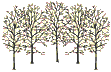
Abnormal growths caused by insects

This young pin oak tree in Hopkinsville, KY, is sadly afflicted with galls. Galls are spots of abnormal growth caused by an insect. A gall can develop in any part of a plant that an insect can burrow into, and in oak twig galls, the insect is usually a small wasp.
The various university extensions are a great source of information about tree problems like this. Here's a summary of the life-stages of gall wasps from North Carolina State University Extension.
Many gall wasps develop for 2 or 3 years in woody galls on the twigs of oaks. Adults then emerge from the twig galls during the winter. They lay eggs in the buds and die. When these eggs hatch, and new growth resumes on the oak, salivary secretions of the gall wasp grub act as powerful plant growth regulators and force the tree to form the gall. Gall wasp galls typically have an outer wall, a spongy fiber layer and a hard, seedlike structure inside of which the gall wasp grub develops. Although gall wasp grubs have chewing mouthparts, they do not seem to chew plant tissue. Evidently the gall secretes nutrients which the grubs lap up.
Source: Galls on Oaks, by James R. Baker and S. B. Bambara, Extension Entomologists at North Carolina State University.
Branches with galls should be removed and destroyed before the tree's infestation becomes serious. Spraying with insecticides is rarely effective because the wasp spends most of its life as a larva, protected inside the gall. There's a small window of opportunity when it emerges to lay eggs.
A University of Kentucky publication about oak galls states that the weight of the galls can cause stress on infected branches, and the deformation can girdle (thus killing, I assume) a branch.
While researching for this post, I learned some sad news (it was news to me!) about oak trees and galls:
Oaks can have numerous types of galls. Out of the over 800 species of gall making wasps in North America, 731 of them attack oaks. Oak deformities are of various sizes, shapes, and colors on leaves, twigs, flowers, acorns and buds. Galls are so commonly found on oaks that many people think the galls are typical parts of the plants.
Source: "Trees With a Lot of Gall (growths called galls on trees)" by Sandra Mason of the University of Illinois Extension.
I have only seen one other oak around here as badly deformed with galls as the little tree in the photo is. The other tree is a mature pin oak, and it is a sad sight indeed. I'm going to try to watch our oaks here at the house carefully. Hopefully we can "nip the problem in the bud" if it occurs.


 "The power to recognize trees at a glance without examining their leaves or flowers or fruit as they are seen, for example, from the car-window during a railroad journey, can only be acquired by studying them as they grow under all possible conditions over wide areas of territory. Such an attainment may not have much practical value, but once acquired it gives to the possessor a good deal of pleasure which is denied to less fortunate travelers."
1 comments -- please add yours:
I have two large pin oak trees in my lawn. One became heavily infected with galls about 4 years ago. The other has not become infected. I was told the infected tree would die. It has not. The gall-infected branches have died, but the tree has produced many new branches. The tree continues to produce an abundance of acorns and is a favorite of the local squirrels. Surprisingly, for reasons unknown to me, the unaffected tree produces no acorns. Would appreciate any information concerning this situation.
Post a Comment