Tree Notes is about trees -- especially native trees, trees for wildlife, and trees in history.

Showing posts with label historic trees. Show all posts

Wednesday, November 10, 2010

Live Oaks of Bonaventure Cemetery

Historic trees in Savannah GA


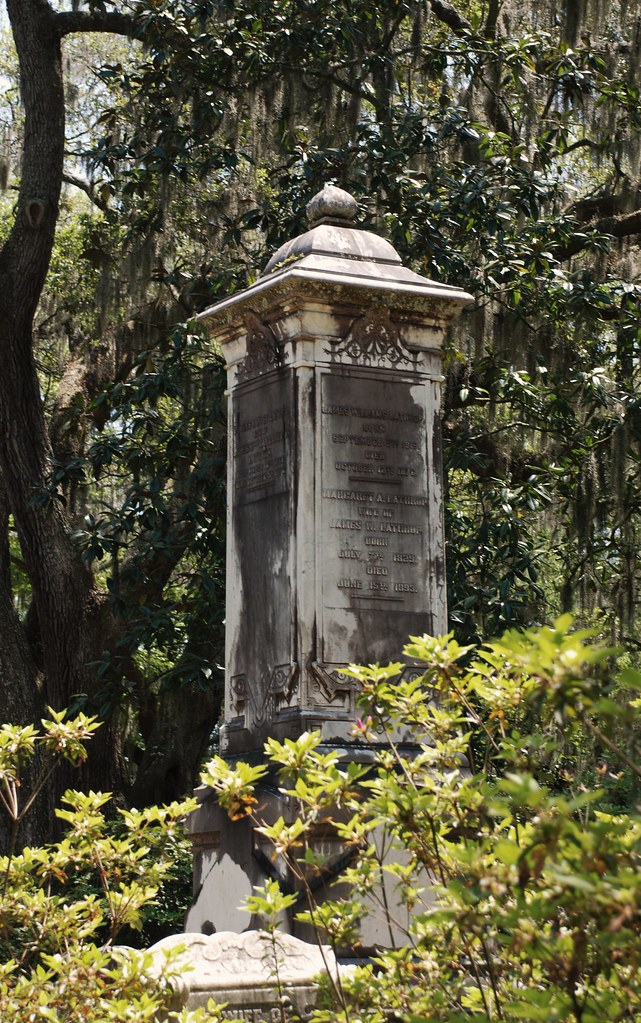
Bonaventure Cemetery (Image by reynolds.james.e)

Should I have the opportunity to travel to Savannah, Georgia, I want to visit the Bonaventure Cemetery. It is known for its beautiful live oaks (Quercus virginiana) and for being the burial place of Johnny Mercer and Conrad Aiken. I've been curious about it ever since reading Midnight in the Garden of Good and Evil.

Bonaventure Cemetery overlooks the Wilmington River. The site was once part of a 600 acre farm named Bonaventure, established in 1762 by Colonel John Mullryne and his wife Claudia. Colonel Mullryne laid out an internal road system for the property and planted live oaks at close intervals along the roadsides. Some of these roadways today are the famous "oak alleys" of Bonaventure Cemetery.
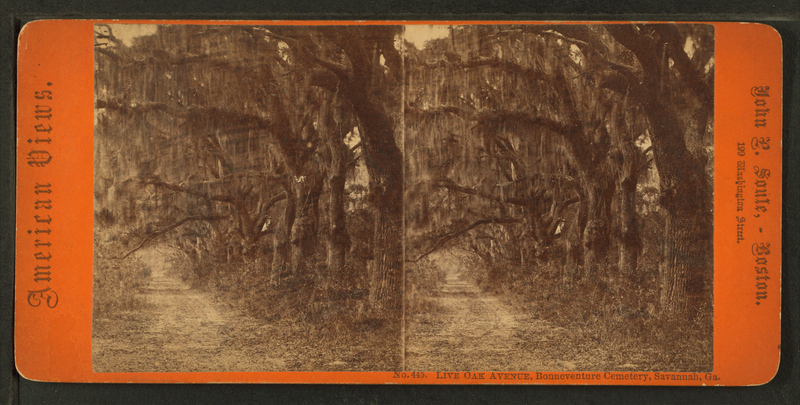
An antique stereoscopic view of
an oak alley at Bonaventure Cemetery.
Image from Wikimedia Commons

A family cemetery was established in the 1790s by a later owner of the plantation, Josiah Tattnall. The Tattnall family sold the plantation in 1846 to Peter Wiltberger. The Wiltbergers opened a 70-acre public cemetery (Evergreen Cemetery) on the property and assumed care of the original Tattnall burying ground (Old Bonaventure Cemetery). Evergreen Cemetery was taken over by the city of Savannah in 1907. The entire site, now 160 acres, is known as Bonaventure Cemetery today.

Donald Grant Mitchell wrote about Bonaventure Cemetery in Rural Studies: With Hints for Country Places. This book was published in 1867, so the live oaks were probably about 100 years old at the time of his visit.

Near to Savannah, in Georgia, and upon one of the creeks making into the irregular shores thereabout, is a cemetery called, if I remember rightly, Buena Ventura. In old times, any visitor at the Pulaski used to find his way there, and was richly repaid for the visit.

There was no proper "keeping" to the grounds. You passed in under a lumbering old gateway of unhewn timber; the paths were not carefully tended; there was much of rampant and almost indecorous undergrowth; the tombs were mossy, and the graves, many of them, sunken; but great liveoaks over-reached your path, and from their gnarled limbs hung swaying pennants of that weird gray moss of the Southern swamp lands—festooned, tangled, streaming down—now fluttering in a light breeze, and again drooping, as if with the weight of woe, to the very earth.

There was something mysteriously solemn and grave-like in it. The gnarled oaks and the slowly swaying plumes of gray told the completest possible story of the place. Had there been no tombs there, you would have said that it was the place of places where tombs should lie and the dead sleep. I have alluded to the scene only to show what and how much may be done by foliage and tree limbs, with their investing mosses, to give character to such a spot. (Source)

In A Thousand Mile Walk to the Gulf, John Muir recalled the days he spent camping in the Bonaventure Cemetery in 1867 while he was waiting in Savannah for money to arrive. Of the live oaks, he wrote:

The most conspicuous glory of Bonaventure is its noble avenue of live-oaks. They are the most magnificent planted trees I have ever seen, about fifty feet high and perhaps three or four feet in diameter, with broad spreading leafy heads. The main branches reach out horizontally until they come together over the driveway, embowering it throughout its entire length, while each branch is adorned like a garden with ferns, flowers, grasses, and dwarf palmettos.

But of all the plants of these curious tree-gardens the most striking and characteristic is the so-called Long Moss (Tillandsia usneoides). It drapes all the branches from top to bottom, hanging in long silvery-gray skeins, reaching a length of not less than eight or ten feet, and when slowly waving in the wind they produce a solemn funereal effect singularly impressive. (Source)

Live oaks at Bonaventure Cemetery, early 1900s.
Library of Congress, Prints and Photographs
Division, Detroit Publishing Company Collection.

Bonaventure Cemetery
Image by bp6316 is BACK
I doubt if the cemetery is as overgrown and natural a place today as it once was, but its live oaks are still there. In 2004, they were placed on the Georgia Landmark and Historic Tree Register.

The Savannah Department of Cemeteries reports that the live oaks have been in "slow decline" for the last century, after surviving a number of major hurricanes during the 1800s. I hope that some younger live oaks are growing so the unique atmosphere and beauty of Bonaventure Cemetery is preserved for future generations.

Further reading
Quercus virginiana
Live Oak, USDA Forest Service Sylvics Manual
Floridata: Quercus virginiana
Discover the Bonaventure Cemetery
Bonaventure Cemetery, Savannah

Monday, October 19, 2009

The Spotsylvania Stump

Battle-ravaged tree, preserved at the Smithsonian Institute


A few years ago, we spent four days visiting the Smithsonian Institute in Washington, D.C. To say that the museums are packed with interesting exhibits is an understatement; the Smithsonian must be experienced to appreciate it. I wish we lived closer!

At the time we visited, the Museum of American History was closed for renovations. A small exhibit from the history museum, "Treasures of American History", was set up in the Museum of  Air and Space.

The history museum's curators chose about 150 items to represent American culture and history, including Mr. Roger's sweater, the ruby slippers from the Wizard of Oz, R2D2 and his buddy CP3O,  the ENIAC, Thomas Jefferson's Bible, George Armstrong Custer's coat, George Washington's uniform and battle sword, Abraham Lincoln's top hat, and the Spotsylvania stump.

The Spotsylvania Stump is all that remains of a large oak tree that once grew in a meadow near Spotsylvania, Virginia. On May 7-19, 1864, Union and Confederate troops engaged in the Battle of the Spotsylvania Courthouse. On May 12, 1864, during a fierce encounter, the oak tree was mutilated by hundreds of bullets from small arms. During the battle, the tree's trunk broke, leaving only a stump standing. Estimates of the number of casualties vary, but 25,000 or more Union and Confederate troops were killed or wounded.

About a year later, the fallen oak tree had disappeared -- hacked up and carried away by souvenir hunters. Even the shattered trunk had been dug out of the ground and removed. When a Union division visited the battlefield and discovered that the stump was missing, Major General Nelson A. Miles made inquiries and located it in the smokehouse of an inn proprietor. Miles confiscated the stump and presented it to the U.S. Secretary of War.  (Source.)

The oak tree's trunk, just below the place where it was severed, was 22 inches in diameter. The stump still contains bullets that it took the day the Spotsylvania meadow became a battlefield. It is a testimony to the ferocity of the fighting and the tremendous destruction of life that occurred at Spotsylvania and other Civil War battlefields.

Credit: Museum of American History photo from Wikipedia.

Tuesday, January 22, 2008

A Reader Asks for Tree Identification

Mysterious trees on Oak Island


I've always said that one of the most interesting things about blogging is the comments, both on the blog and via e-mail. Here's one I received a few days ago.

Dear Genevieve,

I am studying a species of Oak which is non-native to Eastern Canada. To date, my colleagues and I have been unable to identify which species of Quercus it is. The last tree disappeared sometime in the late 1960's, so all that we have to work with is the pictures of these trees. Do you think that you could take a look and render an opinion for us?

Robert


I wrote back:

I will be glad to look, but please keep in mind that I am just an interested amateur, not a trained professional!


Robert sent the following image and a little more information about it:

Many thanks, Genevieve. These Oak trees were found on Oak Island, off of the coast of Nova Scotia, Canada. They are not native to the region and are not found anywhere else, but on this island up to about 1969 or so, when the last ones disappeared. I suspect that they were planted there specifically by early visitors, perhaps between 1560 and 1670. They are unusual because of their broad canopies. Image attached. Thanks again and I surely hope that you recognize them!


I didn't recognize the trees, and I wrote back:

I am not able to identify them, I regret to say. Their shape is curious, not so much because of the broad canopy, but because of the apparent lack of foliage below the canopy. I wonder if that might have been a phenomenon caused by the stress of growing in an environment that wasn't its natural home?

If you'd like, I can post the image on the blog and see if anyone else has any comments.


Robert replied:

Many thanks for taking a look, Genevieve. I would be grateful to learn anything else about them, so a post on your blog would be great. We thought that we had a sample of the trees from a log found on the island. I sent a sample for analysis to the Center for Wood Analysis Research and it came back as a species of Maple. I suspect that we had the wrong stump, as the common belief was and is that they are a species of Oak...

Your insight regarding the environment is probably correct. The unusual shape of the canopy, etc. is likely the result of the North Atlantic seaboard environment, which is known to be harsh as a result of the Nor'easters, as well as perhaps the soil and other conditions. In any event, they apparently thrived there for a number of centuries and of course, is why Oak Island is so named. We believe that they were planted there specifically for timber used in the repair (careening) of ships, but this is just a theory. Hopefully, someone will recognize them from the image, so I will keep my fingers crossed!


Robert is a member of an Oak Island research group. If you're not familiar with the story of Oak Island, it is fascinating. The story was new to me, but my son was well-informed about the mysterious treasure hole and the many attempts that have been made to explore it, having read about it in his some of his "mysteries of the unexplained" books.

Readers, do you recognize the tall trees in the image above, or do you have any comments about them? If so, please post them, or let me know by e-mail. Thanks.

Thursday, November 8, 2007

Champion white oaks

Kentucky's champion white oak compared to past and present national champions


The current champion white oak for the state of Kentucky grows in Logan County, a couple counties east of where I live. It is 270 inches in circumference (about 22.5 feet.) It's height is 94 feet and the spread of its crown is 104 feet. With 390 points, it ranks as one of the biggest trees in my state -- a "monster" of a white oak in our day!

I'm a bit disappointed that no photograph of this champion white oak is available on the Kentucky's Big Tree Program website.

Wye OakThe Wye Oak of Maryland was the champion white oak of the nation for many years. A windstorm took it down in 2002. Its circumference was well over 31 feet. It was 96 feet in height and the spread of its crown was 115 feet. It was awarded an amazing 508 points for its overall size. At the time of its demise, it was estimated to be over 450 years old.

The photograph of the Wye Oak at right was taken by E.H. Pickering, in December of 1936. The image is part of the Historic American Buildings Survey on the Library of Congress website.

The current champion white oak for the nation grows in the Lawrenceville, Virginia, area. It has been awarded 427 points. It is 86 feet tall and 32 feet in diameter. If there's a photograph of it on the internet, I haven't found it yet.

Related:
The Wye Oak Gallery

Wednesday, November 7, 2007

White oak bark and leaves

Quercus alba, foliage and trunk


Quercus alba bark and leavesOne of the most helpful tree-identification things I've learned lately is that the sinuses of oak leaves at the top of the tree will be more deeply cut than those at the bottom of the tree. (Sinuses are the indentations between the lobes.) Apparently, a leaf that is getting plenty of sunshine doesn't need as much surface area as a leaf that is growing in the shade.

The white oak leaves in the image above are a good example. The leaves at the top of the tree (in the background at the top of the photo) have much deeper sinuses than those at the bottom of the tree (foreground.)

Bark of quercus albaWhite oak bark is quite distinctive in color. It's actually a light gray, not white, but it's lighter in color than many tree barks. It's often a bit scaly. You can see some scales on the trunk in the above photo at upper left.

Recently, I happened to find a great image of white oak leaves and acorns from the early 1900s in the Kentucky Virtual Library. Its caption mentions that they came from "a monster white oak near Persimmon." Persimmon is a small settlement in Monroe County, Kentucky (north of Tompkinsville, in south central Kentucky.)

Monday, July 30, 2007

America's Atlantic white cedar swamps

Brief history of the Atlantic white cedar, Chamaecyparis thyoides


When the first European settlers came to North America, they found a new-world member of the cypress family. It grew densely, often in pure stands, in the swamplands of the Atlantic coast. This tree was the Atlantic white cedar (Chamaecyparis thyoides,) and its range once stretched from present-day Maine to upper Florida and along parts of the Gulf coast.

The Atlantic white cedar is a tall, straight-growing tree. The settlers soon learned that its wood was resistant to rot and insects, light in weight, and easy to tool. They used Atlantic white cedar lumber for many purposes -- shingles, flooring, furniture, buckets, barrels, shipbuilding, docks, and more.

As time went by, the swamps were cleared of larger trees, then of smaller ones. The trees grew so closely together in dense clumps that it was often hard to cut them one at a time.

Some swamps and former swamps were mined for fallen trees from earlier times that were covered over by earth, peat, silt or muck. The wood of these fallen, buried trees was still sound, though it had been buried for many years.

One of the largest caches of or buried Atlantic white cedar was discovered in the vicinity of Dennisville, New Jersey, in 1812. Some of the trunks pulled out of the Dennisville swamps were as large as 6 feet in diameter, and it was common to find trunks 4 feet in diameter.

The mining of the swamps provided employment to Dennisville residents through the late 1880's. Many of the mined trees were used as shingles; well over half a million shingles were produced in some years. Some of the larger logs were cut into boards.

In Joseph S. Illick's 1926 book, Common Trees of New Jersey, he mentions that Atlantic white cedars were being used as a substitute for chestnut telephone poles because chestnut was becoming hard to find (due to the blight, no doubt.)

Today, Atlantic white cedar swamps have been reduced to about 20% of their original area. Much of the swampland has been cleared and drained for agricultural purposes and various sorts of development. In recent years, interest has grown in restoration of white cedar swamps where possible, and preservation of white cedar swamps that still exist.

The American white cedar is sometimes grown as an ornamental. Many cultivars are available, including blue varieties, dark green varieties, and others with fuzzy-looking foliage. If you have a boggy, swampy area to plant, this would be a tree to consider.

Historic accounts of Atlantic white cedar mining in New Jersey:
History of the Lumber Industry in America (pages 493-495)
Manufacturer and Builder: "The Buried Forests of New Jersey"

More reading about Atlantic white cedar swamps
White Cedar Swamp, Cape Cod National Seashore
Peatland Atlantic white cedar forests in Virginia
White cedar swamp restoration in South Carolina
Trees of the Maritime Forest: Chamaecyparis thyoides
Chamaecyparis thyoides info from U.S. Forest Service database

Tuesday, July 10, 2007

The Waverly (Waverley) Oaks

Some of the biggest white oaks ever known in America


The Waverly (or Waverley) Oaks were a group of very large and very old white oaks that grew near Boston, in a corner where the towns of Watertown, Belmont and Waltham meet. I use the past tense because the last of these big old oaks has apparently died. A monument has been erected in their memory.

About 8 years ago, I first read some articles about the Waverley Oaks in turn-of-the-century periodicals in the Library of Congress (LOC) American Memory website. Two of the most extensive and informative articles were:

The poet, James Russell Lowell, was particularly fond of Beaver Brook and its small waterfall near the ancient oaks. He spoke of the grove of oaks as the "Beaver Brook Oaks," and somehow wrote a poem about Beaver Brook without even mentioning them.

Recently, I've enjoyed reading more about the Waverley Oaks in some of the old books that Google has digitized. In the pieces I've read, there's little agreement about how many trees there were. An 1881 account of the trees, included in a Harpers Magazine article about James Russell Lowell said there were only seven or eight oaks at Beaver Brook and one elm which was dying.

A year later, The Massachusetts Horticultural Society specifically states that the Harpers Magazine article is wrong -- there were twelve or fourteen oaks, not just seven or eight.

I feel sure that Professor C.S. Sargent of Garden and Forest did an accurate count. He was a scientist. He reported in his 1890 article about the Waverly Oaks, "There are in this group, twenty-three large oaks and one large elm growing on an area of two or three acres. The Oaks are all White Oaks with the exception of a single Swamp White Oak."

Similarly, there is much disagreement over the age of the trees with estimates from 100 years to 1000 years and a reported tree-ring count of over 600 on a stump. I don't know who to believe, but I'm inclined again to take the word of Professor Sargent, who wrote that the trees were at most 500 years old.

You can read reports of the enormous size of the trees at the various links I've included here.

Professor Sargent probably wouldn't have liked this sentimental description of the Waverley Oaks, but it's within the age parameters that he granted them.

The magnificent Waverly oaks were mature trees when the keel of the Mayflower touched the gleaming sands of Plymouth harbor.

The south wind played the same soothing melodies through their branches then as now, though the Indian, whose moccasins noiselessly trod the sward at their feet, has vanished from the face of the earth and the humble Pilgrim from Leyden has inspired and created the greatest nation of the civilized world.

The old trees saw the Red man and the Englishman play their parts and are still sturdy—as well they need be— while they listen to the polyglot tongues that now babble around them.

Seasons come and go, leaves ripen and fall, buds unfold into leaf and blossom, but the tree grows on and on and recks not that the white headed old man who thoughtfully reposes in its shade is the same person who sported beneath its limbs in childhood's merry hours.

Source: An 1893 speech by Nathan Mortimer Hawkes

I read in 2001 that the State of Massachusetts was collecting acorns to propagate the last tree of the Waverly Oaks. I can't locate that information on the internet anymore, but I hope the project is still being pursued.

Technorati Technorati tags: , , , ,

Friday, April 27, 2007

The yew-tree of Lorton Vale

An ancient tree immortalized by William Wordsworth


Take a few minutes from your busy day and enjoy this description of a wonderful tree. This is excerpted from William Wordsworth's poem, "Yew-Trees." As you read it, it's helpful to remember that yew wood was used to make bows and arrows.

THERE is a yew-tree, pride of Lorton Vale,
Which to this day stands single, in the midst
Of its own darkness, as it stood of yore:
Not loathe to furnish weapons for the Bands
Of Umfraville or Percy ere they marched
To Scotland's heaths; or those that crossed the sea
And drew their sounding bows at Azincour,
Perhaps at earlier Crecy, or Poictiers.
Of vast circumference and gloom profound
This solitary Tree! -a living thing
Produced too slowly ever to decay;
Of form and aspect too magnificent
To be destroyed...

-- from "Yew-Trees" by William Wordsworth (1770-1850).

The yew tree of Lorton Vale still stands, though part of it broke away in a storm. Previously, it was 27 feet in circumference; now it is is only 13 feet. It is over 1000 years old.

You can read some of Wordsworth's commentary about yew trees at Everypoet.com.

The Lorton Vale yew is believed to be the tree that Quaker preacher George Fox (1624-1691) mentions in his autobiography. The event he describes took place in 1653, and the soldiers he mentions were from Oliver Cromwell's army.

We came the next day to the steeple-house where James Lancaster had appointed the meeting. There were at this meeting twelve soldiers and their wives, from Carlisle; and the country people came in, as if it were to a fair. I lay at a house somewhat short of the place, so that many Friends got thither before me. When I came I found James Lancaster speaking under a yew tree which was so full of people that I feared they would break it down.

I looked about for a place to stand upon, to speak unto the people, for they lay all up and down, like people at a leaguer. After I was discovered, a professor asked if I would not go into the church? I, seeing no place abroad convenient to speak to the people from, told him, Yes; whereupon the people rushed in, so that when I came the house and pulpit were so full I had much ado to get in. Those that could not get in stood abroad about the walls.

When the people were settled I stood up on a seat, and the Lord opened my mouth to declare His everlasting Truth and His everlasting day.George Fox (1624-1691)

About a century later, John Wesley, the leader of a religious movement called Methodism, preached under the Lorton Vale yew as well.

The leaves of Taxus baccata are highly poisonous and they remain poisonous even if they are brown and lying on the ground. For that reason, livestock must not be allowed to graze around a yew-tree. The seeds are also highly poisonous. However, the pulp of the berry-like cone that contains the seed is sweet and is enjoyed by birds.

Related webpages:
  • The Vale of Lorton, Cumbria - Includes a photo of the Lorton Vale yew which survives to this day.
  • Yew - An interesting page by Anna Fraser with descriptions of many traditions associated with the yew as well as a summary of facts.

Credit: Yew leaves & cone image is from Wikimedia Commons.

Friday, February 23, 2007

A Tree Revered by the Indians

Seen near the Bitterroot River by an 1840's traveler

Bighorn sheep, photographed in Montana by
Flickr user Jeremy Weber (doublejwebber)

The Bitterroot river valley of southwestern Montana was once inhabited by the Flathead or Bitterroot Salish Indian tribe, so perhaps they were the people who decorated the tree that is described in the following excerpt. This was written by W. A. Ferris in the early 1840's.

On the east side of Bitter Root river, there is a singular curiosity, that I had not before observed, because it is situated under some rocky bluffs, almost impassable to horsemen, the proper road being on the west side of the river: it is the horn of an animal, called by hunters, the "Big-horn," but denominated by naturalists "Rocky Mountain Sheep;" of a very large size, of which two-thirds of its length from the upper end, is entombed in the body of a pine tree, so perfectly solid and firmly, that a heavy blow of an axe did not start it from its place.

The tree is unusually large and flourishing, and the horn in it some seven feet above the ground. It appears to be very ancient, and is gradually decomposing on the outside, which has assumed a reddish cast. The date of its existence has been lost in the lapse of ages, and even tradition is silent as to the origin of its remarkable situation. The oldest of Indians can give no other account of it, than that it was there precisely as at present, before their father's great grandfathers were born.

They seldom pass it without leaving some trifling offering, as beads, shells, or other ornaments - tokens of their superstitious veneration for it. As high as they can reach, the bark of the tree is decorated with their trifles.

By W. A. Ferris. From Life in the Rocky Mountains, originally published in a series of installments in the Western Literary Messenger, Buffalo, N. Y.: J. S. Chadbourne & Co., from July 13, 1842 to May 4, 1844.

About the area today:
The Bitterroot National Forest, part of which borders the Bitterroot river valley and foothills, has had some terrible fires in recent years. One well-known and horific image of deer fleeing a Bitteroot fire in 2000 has been investigated and certified as genuine by the urban legend sleuths, Snopes.com.

Biologists say that forest fires are both natural and necessary in the coniferous forest. The lodgepole pine, for example, needs fire's intense heat to release its seeds from the cone.

Clipped from a U.S. Forest brochure about
Bitterroot National Forest's Saddle Mountain

Click any label...

advice (45) alder trees (1) Arbor Day (1) ash trees (11) Atlantic white cedar (1) atmosphere (2) autumn (1) bald cypress trees (8) bark (8) bayberry trees (1) beech trees (8) big trees (11) birch trees (2) black cherry trees (1) black locust trees (2) black walnut trees (7) Bradford pear trees (2) buckeye trees (2) butternut trees (1) catalpa trees (4) cherry trees (2) chestnut trees (1) Christmas trees (1) copyright (1) corkwood (1) crabapple trees (1) dogwood trees (6) drought (2) Eastern redbud trees (5) Eastern redcedar (5) ecosystem (6) education (5) elm trees (4) emerald ash borer (11) Empress tree (2) fast growing trees (7) festivals and carnivals (2) fir trees (1) firewood (6) foliage (11) forest (14) forest fires (1) forestry (7) freebies (2) ginkgo trees (1) hackberry trees (4) hawthorn trees (3) hemlock trees (1) hickory trees (11) historic trees (9) history (42) holly trees (1) honeylocust trees (2) hophornbean trees (1) hoptree (1) hornbeam trees (2) internet (3) invasive (13) juniper trees (5) Kentucky coffeetree (2) landscaping (3) larch trees (1) linden trees (1) logging (4) maple trees (10) mimosa trees (3) mistakes (14) narrow trees (1) native fruit (9) native trees (16) oak trees (38) old growth forests (5) ornamental trees (6) osage orange (5) pawpaw trees (1) pecan trees (1) persimmon tree (3) pine trees (9) poems (5) poison-sumac (1) poplar trees (10) prehistoric trees (3) quizzes etc. (1) rhododendron trees (1) sassafras trees (3) serviceberry trees (2) Silver maple trees (2) small trees (4) spring (7) spruce trees (4) statistics (2) sumac trees (4) sweetgum trees (4) sycamore trees (10) tall trees (5) tree cavities (1) tree identification (8) Tree of heaven (2) tree planting (11) tree problems (40) tree removal (2) tree roots (5) trees for problem spots (7) tuliptrees (tulip poplar) (2) urban forest (7) viburnum trees (1) wetlands (5) wild plum trees (4) wildlife trees (27) willow trees (6) witchhazel trees (1) woodworking (2) yellowwood trees (1) yew trees (1)

Enrich your life with the study of trees.

"The power to recognize trees at a glance without examining their leaves or flowers or fruit as they are seen, for example, from the car-window during a railroad journey, can only be acquired by studying them as they grow under all possible conditions over wide areas of territory. Such an attainment may not have much practical value, but once acquired it gives to the possessor a good deal of pleasure which is denied to less fortunate travelers."

Charles Sprague Sargent (1841-1927)

Print references I frequently consult

Benvie, Sam. Encyclopedia of North American Trees. Buffalo, NY: Firefly, 2000.

Brockman, C. Frank. Trees of North America: A Guide to Field Identification. Ed. Herbert S. Zim. New York: Golden, 1986.

Cliburn, Jerry, and Ginny Clomps. A Key to Missouri Trees in Winter: An Identification Guide. Conservation Commission of the State of Missouri, 1980.

Collingwood, G. H., Warren David Brush, and Devereux Butcher. Knowing Your Trees. Washington: American Forestry Association, 1978.

Dirr, Michael. Dirr's Hardy Trees and Shrubs: an Illustrated Encyclopedia. Portland, Or.: Timber, 1997.

Elias, Thomas S. The Complete Trees of North America; Field Guide and Natural History. New York: Book Division, Times Mirror Magazines, 1980.

Grimm, William Carey. The Book of Trees;. Harrisburg, PA: Stackpole, 1962.

Hightshoe, Gary L. Native Trees, Shrubs, and Vines for Urban and Rural America: a Planting Design Manual for Environmental Designers. New York: Van Nostrand Reinhold, 1988.

Little, Elbert L. National Audubon Society Field Guide to North American Trees. New York: Chanticleer, 1996.

Martin, Alexander C., Herbert S. Zim, and Arnold L. Nelson. American Wildlife and Plants. New York: McGraw Hill, 1951.

Mitchell, Alan F., and David More. The Trees of North America. New York, NY: Facts On File Publications, 1987.

Randall, Charles E. Enjoying Our Trees. Washington: American Forestry Association, 1969.

Settergren, Carl D., and R. E. McDermott. Trees of Missouri. Columbia: University Extension, 1995.

Sternberg, Guy, and James W. Wilson. Native Trees for North American Landscapes: from the Atlantic to the Rockies. Portland: Timber, 2004.

Wharton, Mary E., and Roger W. Barbour. Trees and Shrubs of Kentucky. Lexington: University of Kentucky, 1973.

Wyman, Donald. Trees for American Gardens. New York: Macmillan, 1965.

Photos and text copyright © 2006-2013 by Genevieve L. Netz. All rights reserved. Do not republish without written permission. My e-mail address is gnetz51@gmail.com