Tree Notes is about trees -- especially native trees, trees for wildlife, and trees in history.

Tuesday, March 6, 2007

Tree of My Life

Poem by Edward Rowland Sill
(1841 - 1887)


WHEN I was yet but a child, the gardener gave me a tree,
A little slim elm, to be set wherever seemed good to me
What a wonderful thing it seemed! with its lace-edged leaves uncurled,
And its span-long stem, that should grow to the grandest tree in the world!

So I searched all the garden round, and out over field and hill,
But not a spot could I find that suited my wayward will.
I would have it bowered in the grove, in a close and quiet vale;
I would rear it aloft on the height, to wrestle with the gale.

Then I said, "I will cover its roots with a little earth by the door,
And there it shall live and wait, while I search for a place once more."
But still I could never find it, the place for my wondrous tree,
And it waited and grew by the door, while years passed over me;

Till suddenly, one fine day, I saw it was grown too tall,
And its roots gone down too deep, to be ever moved at all.
So here it is growing still, by the lowly cottage door;
Never so grand and tall as I dreamed it would be of yore,

But it shelters a tired old man in its sunshine-dappled shade,
The children's pattering feet round its knotty knees have played,
Dear singing birds in a storm sometimes take refuge there,
And the stars through its silent boughs shine gloriously fair.


"So here it is growing still, by the lowly cottage door..."
Delare Cottage, Dighton, Bristol County, MA
Library of Congress, Prints and Photographs Division,
 Reproduction Number HABS, MASS,3-DIT,6-1

Monday, March 5, 2007

American Wild Plum: Bud and Twig

Prunus americana


Wild plum bud and twigFlower bud of wild plum in early spring

I was out on the south hillside of our small property today where the wild plums grow, and I snapped this photo of the buds. Unfortunately, these plums always bloom early and are almost always caught in a late frost. The warm days on the south-facing bank trick them.

We have another small plum thicket where the ground slopes slightly to the north, and even though they have full sun, they don't bloom until after the last frost and they usually bear fruit.

I started all of our wild plums from seeds. I was given some local wild plums, a sour yellow variety, and I saved some seeds and planted them. The next year, I happened to be in Kansas when the wild plums were fruiting, and I brought back a mess of plums and planted some of their seeds with my local plum seedlings. This was a sweet yellow plum. I can't tell any difference in the appearance of the trees or the fruit, but I can certainly tell which is which by the flavor.

Wild plums send up a lot of suckers, and their natural tendency is to form a thicket. We put them on a sharp bank in our yard that we don't want to mow, and they are doing a good job of taking over. The trick is that you must stop mowing the area where you want the thicket to develop.

I read tonight in a U.S. Dept. of Agriculture publication that three cultivars have been developed from the American wild plum: 'Blackhawk', 'Hawkeye', and 'De Soto.' I would guess that they are sweeter and larger than most wild plums.

I have written more about my personal history with the wild plum in an article on my other blog, Prairie Bluestem. Please see "Wild Fruits of the Nebraska Sandhills"

Saturday, March 3, 2007

Dugout Canoes

Historic facts about an ancient means of transportation


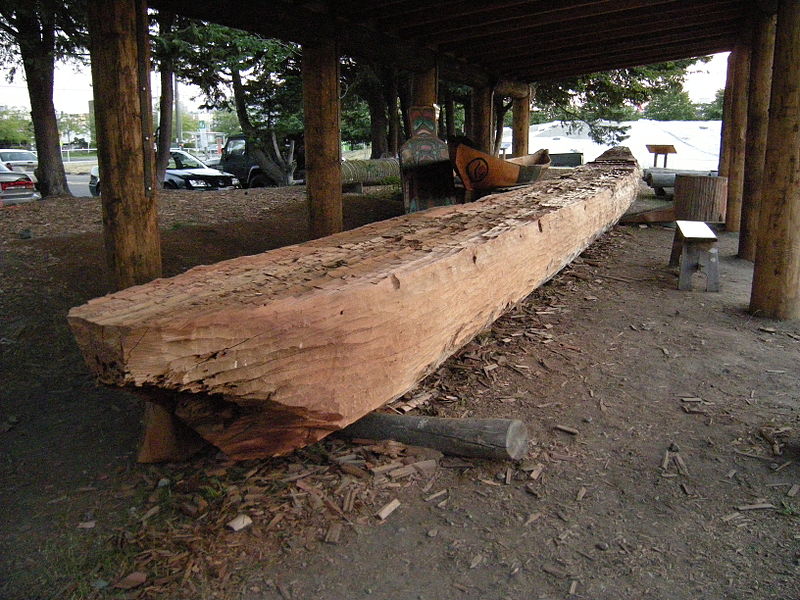
Dugout canoe underway
A barely started dugout canoe being
carved as a youth project with supervision
and participation by Haida carver Saaduuts.
Center for Wooden Boats, Seattle, Washington.
Photo by Joe Mabel.
Dugout canoes were once an important vehicle on the nation's waterways. They were made from the trees that were available on the riverbank.

The ends of the log were shaped into a point and the bottom of the log was somewhat flattened to make the water glide around it easily and to make the log stable in the water. The top and heart of the log were carved out to make a place to sit and carry cargo.

In Kentucky, a dugout maker would have looked for a long, straight cottonwood, tulip poplar, or soft maple (red or silver maple) growing close to the water. Their wood was soft and easy to "dig out."

Jeremy Belknap, a New Hampshire minister who published a history in the late 1700's, recorded that native Americans of that area often used pine or chestnut and a single man could make a dugout canoe in ten to twelve days.

Native Americans on the west coast used dugout canoes in the ocean for whaling and hunting. A large red cedar was preferred.

The oldest dugout that has been discovered in the southeastern U.S. is believed to have been made by the Algonquian Indians. It was made of a bald cypress log, and radiocarbon dating indicates that it's around 4400 years old. It was found in Lake Phelps, a large natural lake in North Carolina. Thirty prehistoric dugout canoes have been found sunk in this lake!

An interesting article in the "Discovering Lewis and Clark" website describes efforts to learn more about the dugout canoes that Lewis and Clark used in their historic exploration of the Louisiana Purchase.

William W. Bevis, the author of the Lewis-and-Clark dugout article, became experienced with dugouts on the rivers of Borneo. It seems that much of what we once knew in this country about making a river-worthy vessel from a log has been forgotten.

Bevis says that dugouts are much more stable in the water than you might imagine. The weight, bottom-heavy shape and low profile of a dugout help it perform well in a river. (A 30-foot dugout can weigh a ton or more!)

The Lewis and Clark expedition made most of its journey across the continent by water. Their diaries indicate that along the way, they made 15 dugouts. The trees they used included cottonwoods and ponderosa pines.

If you want to make your own dugout, Mother Earth News has an article that might be helpful: The Making of a Cedar Dugout Canoe. The Missouri Department of Conservation offers some advice as well: Digging into Dugout History.

"The manner of makinge their boates" by Theodor de Bry after a John White
watercolor. Native Americans make a dugout canoe with seashell scrapers. 1590.
Image from Wikimedia Commons.


Friday, March 2, 2007

Red Blossoms of Silver Maple

Acer saccharinum, water maple, soft maple


Silver maple flowers
Flower of silver maple


Silver maple is one of the first trees to bloom in springtime. Its bright red blossoms are small, but they are a welcome spark of color in the landscape.

The flower buds and flowers of the silver maple are eaten by squirrels in early spring when food is scarce.

Silver maple in bloom
Silver maple blossoms
The silver maple's seeds are the largest of all the maple seeds, and are an important food source for squirrels as well as a large number of songbirds, gamebirds, and wild animals . Even bears, deer, elk, moose, and mountain sheep will feast on silver maple seeds. The seeds appear in spring at about the same time the leaves do.

In nature, the silver maple often chooses to grow in moist bottom lands or at the edges of rivers and lakes. In Kentucky it may be found growing with willows, sycamores, hackberries, cottonwoods and river birch.

The silver maple in the photo below is growing near Kentucky Lake in western Kentucky. In this location, the tree probably stands in water occasionally, but the silver maple can survive some flooding.

Silver maples are often sold in garden centers as a fast-growing shade tree. They are prone to storm damage because of their weak, brittle branches, and they are a short-lived tree that will mature at 50 to 75 years and slip into decline soon thereafter. The silver maple is well-known for clogging drains with its water-seeking roots.

Think carefully about where you want to plant this tree! We have three silver maples near our house, planted by a former owner. We've seen some severe storm damage in them several times. Fortunately -- so far! -- none of the large limbs have hit the house.

One of the trees is very large and probably at full maturity. When its health begins to decline (which will be soon,) we will be forced to remove it because of its proximity to the house.

Silver maple at lake edge
Silver maple flowering at Kentucky Lake, near Fenton

Thursday, March 1, 2007

I Want a Persimmon Tree!

Diosppyros virginiana, possum tree, possumwood, common persimmon


I've been thinking about planting a persimmon tree. Persimmon trees are native to this area (and to the entire southeastern United States.)


Around here, people call them "possum trees" because possums love the fruit and will climb the tree to get it. The fruit is popular with raccoons, skunks, foxes, mice, deer, and various birds as well.

Persimmon leaf and bark
USDA photo
The wildlife value of the tree is nice, but I hope there will be enough fruit left for us people, too! I have been reading persimmon recipes for years and I want to try some of them. I have enjoyed the persimmon desserts I've tasted a few times at church potlucks.

The tree is a member of the ebony family, and its very distinctive bark helps to identify it when fruit is not present. The bark is black with blocks arranged in a grid pattern. If you look between the plates, you can see an orange coloration (more obvious on younger persimmon trees.) The bark on older persimmons looks like a wooden representation of alligator skin!

Here's something interesting from history about the flavor of the persimmon: Captain John Smith of Jamestown fame wrote in 1607, "...the fruit [the persimmon] is like a medlar; it is first green, then yellow and red when it is ripe: if it is not ripe, it will drive a man's mouth awrie with much torment, but when it is ripe, it is as delicious as the apricot.."

I know where a persimmon tree grows in the backyard of an old store building. I had been thinking about looking around for a seedling or collecting some seed next fall when the fruit drops.

However, I read somewhere tonight that the tree is best propagated with a root cutting. So I don't know! This old store building sits next to someone's house, and maybe they won't want me to dig around in the yard looking for a root! I would have to ask permission even to look for a seedling.

It may be best to just buy a persimmon tree. A cultivar called "Meador" has been selected for sweetness and is available from nurseries.


Another "Tree Note"Persimmons are not too fussy about where they're planted. They send down a deep taproot, so they can tolerate a dry location. They don't mind heavy soil but they don't like shade. A persimmon should do OK in the site I can offer it, a well-drained south-facing spot on the edge of a broad ridge.

Click any label...

advice (45) alder trees (1) Arbor Day (1) ash trees (11) Atlantic white cedar (1) atmosphere (2) autumn (1) bald cypress trees (8) bark (8) bayberry trees (1) beech trees (8) big trees (11) birch trees (2) black cherry trees (1) black locust trees (2) black walnut trees (7) Bradford pear trees (2) buckeye trees (2) butternut trees (1) catalpa trees (4) cherry trees (2) chestnut trees (1) Christmas trees (1) copyright (1) corkwood (1) crabapple trees (1) dogwood trees (6) drought (2) Eastern redbud trees (5) Eastern redcedar (5) ecosystem (6) education (5) elm trees (4) emerald ash borer (11) Empress tree (2) fast growing trees (7) festivals and carnivals (2) fir trees (1) firewood (6) foliage (11) forest (14) forest fires (1) forestry (7) freebies (2) ginkgo trees (1) hackberry trees (4) hawthorn trees (3) hemlock trees (1) hickory trees (11) historic trees (9) history (42) holly trees (1) honeylocust trees (2) hophornbean trees (1) hoptree (1) hornbeam trees (2) internet (3) invasive (13) juniper trees (5) Kentucky coffeetree (2) landscaping (3) larch trees (1) linden trees (1) logging (4) maple trees (10) mimosa trees (3) mistakes (14) narrow trees (1) native fruit (9) native trees (16) oak trees (38) old growth forests (5) ornamental trees (6) osage orange (5) pawpaw trees (1) pecan trees (1) persimmon tree (3) pine trees (9) poems (5) poison-sumac (1) poplar trees (10) prehistoric trees (3) quizzes etc. (1) rhododendron trees (1) sassafras trees (3) serviceberry trees (2) Silver maple trees (2) small trees (4) spring (7) spruce trees (4) statistics (2) sumac trees (4) sweetgum trees (4) sycamore trees (10) tall trees (5) tree cavities (1) tree identification (8) Tree of heaven (2) tree planting (11) tree problems (40) tree removal (2) tree roots (5) trees for problem spots (7) tuliptrees (tulip poplar) (2) urban forest (7) viburnum trees (1) wetlands (5) wild plum trees (4) wildlife trees (27) willow trees (6) witchhazel trees (1) woodworking (2) yellowwood trees (1) yew trees (1)

Enrich your life with the study of trees.

"The power to recognize trees at a glance without examining their leaves or flowers or fruit as they are seen, for example, from the car-window during a railroad journey, can only be acquired by studying them as they grow under all possible conditions over wide areas of territory. Such an attainment may not have much practical value, but once acquired it gives to the possessor a good deal of pleasure which is denied to less fortunate travelers."

Charles Sprague Sargent (1841-1927)

Print references I frequently consult

Benvie, Sam. Encyclopedia of North American Trees. Buffalo, NY: Firefly, 2000.

Brockman, C. Frank. Trees of North America: A Guide to Field Identification. Ed. Herbert S. Zim. New York: Golden, 1986.

Cliburn, Jerry, and Ginny Clomps. A Key to Missouri Trees in Winter: An Identification Guide. Conservation Commission of the State of Missouri, 1980.

Collingwood, G. H., Warren David Brush, and Devereux Butcher. Knowing Your Trees. Washington: American Forestry Association, 1978.

Dirr, Michael. Dirr's Hardy Trees and Shrubs: an Illustrated Encyclopedia. Portland, Or.: Timber, 1997.

Elias, Thomas S. The Complete Trees of North America; Field Guide and Natural History. New York: Book Division, Times Mirror Magazines, 1980.

Grimm, William Carey. The Book of Trees;. Harrisburg, PA: Stackpole, 1962.

Hightshoe, Gary L. Native Trees, Shrubs, and Vines for Urban and Rural America: a Planting Design Manual for Environmental Designers. New York: Van Nostrand Reinhold, 1988.

Little, Elbert L. National Audubon Society Field Guide to North American Trees. New York: Chanticleer, 1996.

Martin, Alexander C., Herbert S. Zim, and Arnold L. Nelson. American Wildlife and Plants. New York: McGraw Hill, 1951.

Mitchell, Alan F., and David More. The Trees of North America. New York, NY: Facts On File Publications, 1987.

Randall, Charles E. Enjoying Our Trees. Washington: American Forestry Association, 1969.

Settergren, Carl D., and R. E. McDermott. Trees of Missouri. Columbia: University Extension, 1995.

Sternberg, Guy, and James W. Wilson. Native Trees for North American Landscapes: from the Atlantic to the Rockies. Portland: Timber, 2004.

Wharton, Mary E., and Roger W. Barbour. Trees and Shrubs of Kentucky. Lexington: University of Kentucky, 1973.

Wyman, Donald. Trees for American Gardens. New York: Macmillan, 1965.

Photos and text copyright © 2006-2013 by Genevieve L. Netz. All rights reserved. Do not republish without written permission. My e-mail address is gnetz51@gmail.com