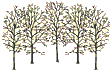
Poplar trees passing from maturity to old age
 |
| Grove of cottonwoods at a ranch entrance in the Nebraska Sandhills, about 1957 |
Note: As you read this, you must remember that in the Nebraska Sandhills, there are no natural forests. The Sandhills are one of the great prairies of North America.
The grove of cottonwood (Populus deltoides) trees pictured above was the first thing you saw at the Sandhill ranch where I grew up. They towered above the west side of our ranch road, from our mailbox to the first auto-gate.
When my brother and I walked home from school, I liked to crawl under the fence at the mailbox and walk through these trees. I had never walked through a real forest, but I imagined that a forest would be something like this grove -- a quiet place shaded by tall, majestic trees. This mighty stand of cottonwoods seemed much more like a forest than the shelter-belts around our house. In the shelter-belts, the trees were short and bushy, and they grew in rows.
On windy days, I looked up and saw the tops of the trees moving, but the wind was not as strong at ground level inside the grove as it was outside it. Even though the trees were widely spaced, they seemed to slow the wind. My father knew this fact, as well. On bitter winter days, he sometimes fed the cattle their hay under these trees.¹
I brought my children to visit my childhood home in 1999. It had been about 25 years since my parents moved their ranching operation to Missouri, and I left Nebraska. I was shocked to see that many of the trees in the cottonwood "forest" of my childhood were dead or dying. I suppose the grove was planted by homesteaders after they began settling in Duff Valley in the 1880s. A cottonwood rarely lives more than a century. I knew that, of course, but I still imagined that my cottonwoods would live forever.
 |
| The same grove of cottonwoods, roughly 40 years later |
Related:
Cottonwood trees of my childhood
¹The following paragraph from an Australian farm forestry page describes the same phenomenon:
In the case of scattered trees, the strongest winds tend to flow evenly over the top of the canopies, leaving the wind speeds at ground level much lower over the whole area. Measurements taken amongst widely spaced trees spread across grazing land indicate that reductions in wind speed of 40% over the whole paddock are possible with just 17 large remnant eucalypt trees per hectare, or about 200 young pruned timber trees per hectare. The larger the trees or the greater the stocking rate, the slower the wind speed will be. Such areas may be valuable as stock havens for ‘off-shears’ sheep or developed as special lambing or calving areas. (Source: "Trees for Wind Shelter")


 "The power to recognize trees at a glance without examining their leaves or flowers or fruit as they are seen, for example, from the car-window during a railroad journey, can only be acquired by studying them as they grow under all possible conditions over wide areas of territory. Such an attainment may not have much practical value, but once acquired it gives to the possessor a good deal of pleasure which is denied to less fortunate travelers."


